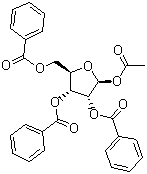
beta-D-Ribofuranose 1-acetate 2,3,5-tribenzoate is a fully protected derivative of D-ribose in which the hydroxyl groups at the 2, 3, and 5 positions are esterified with benzoyl groups and the anomeric hydroxyl at the 1 position is converted into an acetate. The sugar adopts the furanose ring form, and the configuration at the anomeric center is beta. Compounds of this type emerged from early twentieth-century studies on carbohydrate protection, when systematic acylation methods were developed to control the reactivity of polyhydroxylated sugars. The introduction of benzoyl protecting groups became an established approach because benzoyl esters are stable under a wide range of reaction conditions and can be removed under controlled basic hydrolysis.
The preparation of benzoylated ribofuranose derivatives followed advances in acylation chemistry using benzoyl chloride or benzoic anhydride in the presence of base. Selective protection of the 2, 3, and 5 hydroxyl groups in ribose provided intermediates suitable for further modification at the anomeric position. Conversion of the anomeric hydroxyl into an acetate furnished a compound that could serve as a glycosyl donor under appropriate activation conditions. During the development of nucleoside chemistry in the mid-twentieth century, protected ribofuranose derivatives played a central role because ribose is the sugar component of ribonucleic acid.
One major application of beta-D-ribofuranose 1-acetate 2,3,5-tribenzoate has been in the synthesis of nucleosides. In classical glycosylation procedures, acyl-protected ribofuranose derivatives were coupled with heterocyclic bases to form the N-glycosidic bond characteristic of ribonucleosides. The benzoyl groups at the 2 and 3 positions help direct stereochemical outcome and protect the sugar during condensation reactions. After formation of the glycosidic linkage, the benzoyl and acetyl protecting groups can be removed under hydrolytic conditions to yield the free nucleoside. Such methodologies contributed to the laboratory synthesis of naturally occurring ribonucleosides and their analogs, which have been important in biochemical and medicinal research.
Beyond nucleoside synthesis, this protected ribofuranose derivative has been used in studies of glycosylation mechanisms. The presence of acyl groups influences neighboring group participation, which can affect the stereochemical course of reactions at the anomeric center. Investigation of benzoyl-protected ribose acetates has provided insight into the formation of beta-linked products and the role of acyl substituents in stabilizing reaction intermediates. These mechanistic studies have informed the design of improved glycosyl donors for carbohydrate and nucleoside synthesis.
The compound has also served as a reference substrate in analytical and structural investigations. Spectroscopic characterization, including nuclear magnetic resonance analysis, has been performed on tribenzoylated ribofuranose acetates to confirm ring conformation and anomeric configuration. Such data have supported the assignment of stereochemistry in related ribose derivatives and have contributed to a broader understanding of furanose ring behavior.
The development and application of beta-D-ribofuranose 1-acetate 2,3,5-tribenzoate reflect the evolution of protecting group strategies in carbohydrate chemistry. By stabilizing reactive hydroxyl groups and enabling controlled formation of glycosidic bonds, acyl-protected ribose derivatives have been integral to the synthesis of biologically significant molecules. Their documented use in nucleoside preparation and mechanistic research underscores their importance in both fundamental carbohydrate chemistry and the advancement of nucleic acid science.
References
2023. Synthesis and Antitubercular Activity of New 5-Alkynyl Derivatives of 2-Thiouridine. Russian Journal of Organic Chemistry.
DOI: 10.1134/s1070428023120047
|




 GHS07 Warning Details
 Discovory and Applicatios