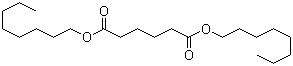
Dioctyl adipate (DOA), also known as di(2-ethylhexyl) adipate, is an aliphatic diester formed from adipic acid and 2-ethylhexanol, with the molecular formula C22H42O4. It is a clear, colorless to pale yellow oily liquid with low viscosity and a mild odor. Dioctyl adipate is insoluble in water but readily soluble in most organic solvents and highly compatible with many polymer systems, particularly poly(vinyl chloride) (PVC) and synthetic rubbers.
The development of dioctyl adipate is closely linked to the evolution of plasticizer technology during the mid-20th century. As the plastics and elastomer industries expanded, there was increasing demand for plasticizers that could provide improved low-temperature flexibility compared with traditional aromatic phthalates. Aliphatic adipate esters were identified as effective alternatives due to their flexible molecular structure and favorable cold-temperature performance. Dioctyl adipate emerged as a widely used plasticizer because it offered good compatibility with PVC while significantly lowering brittleness at sub-ambient temperatures.
Industrial production of dioctyl adipate is typically carried out by esterification of adipic acid or adipic anhydride with 2-ethylhexanol under acidic catalysis. The reaction is conducted at elevated temperatures, with continuous removal of water to shift the equilibrium toward ester formation. After completion, the reaction mixture undergoes neutralization, washing, and vacuum distillation to remove unreacted alcohol, catalyst residues, and low-boiling impurities. The resulting product is refined to meet specifications for color, purity, and acid value required for industrial use.
Chemically, dioctyl adipate functions as a plasticizer by inserting itself between polymer chains, reducing intermolecular attractions and increasing chain mobility. Its long, branched alkyl chains and flexible aliphatic adipate backbone contribute to excellent low-temperature properties and resistance to crystallization. Compared with aromatic ester plasticizers, dioctyl adipate generally exhibits lower density, lower viscosity, and improved flexibility at low temperatures, though it may have slightly higher volatility under elevated heat conditions.
In practical applications, dioctyl adipate is primarily used as a low-temperature plasticizer for PVC. It is commonly employed in flexible films, sheets, hoses, synthetic leather, wire and cable insulation, and food-packaging-related materials where cold resistance is critical. It is also used in formulations for coatings, sealants, and adhesives, as well as in certain rubber and elastomer products to enhance flexibility and softness. Its relatively low toxicity profile has supported its use in applications requiring improved safety characteristics compared with some aromatic plasticizers.
Physically, dioctyl adipate remains fluid over a wide temperature range and provides excellent resistance to embrittlement at low temperatures. It has low water solubility, good hydrolytic stability under neutral conditions, and moderate resistance to extraction by oils and fuels. Storage is typically in sealed containers away from strong oxidizing agents and excessive heat. Standard industrial hygiene practices are recommended during handling to avoid prolonged skin contact.
Overall, dioctyl adipate is an important aliphatic ester plasticizer whose development addressed the need for enhanced low-temperature performance in flexible polymer materials. Its ability to impart softness, elasticity, and cold resistance has made it a valuable component in PVC and elastomer formulations, particularly where performance under low-temperature conditions is a critical requirement.
References
2025. Modeling of solvent diffusion characteristics and thermal degradation behaviors of hybrid CB/Silica filled ENR/CR/HNBR ternary elastomeric composites. Emergent Materials.
DOI: 10.1007/s42247-025-01132-6
2025. Synthesized the cold-resistant plasticizer epoxidized 1,6-hexanediol oleate and effects on the properties of polyvinyl chloride. Polymer Bulletin.
DOI: 10.1007/s00289-024-05420-9
|




 GHS07 Warning Details
 Discovory and Applicatios