
Online Database of Chemicals from Around the World
| wuhan chemi Pharmacy Chemical Technology Co., Ltd. | China | |||
|---|---|---|---|---|
 | www.chemipharm.com.cn | |||
 | +86 13971619949 | |||
 | gmn424@chemipharm.com.cn | |||
 | QQ Chat | |||
 | WeChat: 13971619949 | |||
| Chemical manufacturer since 2014 | ||||
| chemBlink Standard supplier since 2026 | ||||
| Apollo Scientific Ltd. | UK | |||
|---|---|---|---|---|
| www.apolloscientific.co.uk | |||
| +44 (161) 406-0505 | |||
 | +44 (161) 406-0506 | |||
| sales@apolloscientific.co.uk | |||
| Chemical manufacturer | ||||
| Aces Pharma, Inc. | USA | |||
|---|---|---|---|---|
| www.acespharma.com | |||
| +1 (203) 488-5529 | |||
| +1 (203) 488-5578 | |||
| sales@acespharma.com | |||
| Chemical manufacturer since 2009 | ||||
| FCH Group | Ukraine | |||
|---|---|---|---|---|
| www.fchgroup.net | |||
| +38 (044) 228-9649 | |||
| +38 (044) 495-8816 | |||
| info@fchgroup.net | |||
| Chemical manufacturer | ||||
| Ryan Scientific, Inc. | USA | |||
|---|---|---|---|---|
| www.ryansci.com | |||
| +1 (843)-884-4911 | |||
| +1 (843) 884-5568 | |||
| sales@ryansci.com | |||
| Chemical manufacturer | ||||
| Classification | Pharmaceutical intermediate >> Heterocyclic compound intermediate >> Pyrimidine compound >> Methoxypyrimidine |
|---|---|
| Name | 2-Amino-4-methoxypyrimidine |
| Synonyms | 4-Methoxypyrimidin-2-amine |
| Molecular Structure | 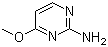 |
| Molecular Formula | C5H7N3O |
| Molecular Weight | 125.13 |
| CAS Registry Number | 155-90-8 |
| EC Number | 803-357-8 |
| SMILES | COC1=NC(=NC=C1)N |
| Density | 1.2±0.1 g/cm3 Calc.* |
|---|---|
| Boiling point | 313.1±34.0 °C 760 mmHg (Calc.)* |
| Flash point | 143.2±25.7 °C (Calc.)* |
| Index of refraction | 1.567 (Calc.)* |
| * | Calculated using Advanced Chemistry Development (ACD/Labs) Software |
| Hazard Symbols |  GHS07 Warning Details GHS07 Warning Details | ||||||||||||||||||||||||
|---|---|---|---|---|---|---|---|---|---|---|---|---|---|---|---|---|---|---|---|---|---|---|---|---|---|
| Risk Statements | H302-H315-H335 Details | ||||||||||||||||||||||||
| Safety Statements | P261-P264-P270-P271-P280-P301+P317-P302+P352-P304+P340-P319-P321-P330-P332+P317-P362+P364-P403+P233-P405-P501 Details | ||||||||||||||||||||||||
| Hazard Classification | |||||||||||||||||||||||||
| |||||||||||||||||||||||||
| SDS | Available | ||||||||||||||||||||||||
 chemBlink Chemical Story
|
2-Amino-4-methoxypyrimidine is a substituted pyrimidine derivative containing an amino group at the 2-position and a methoxy group at the 4-position of the pyrimidine ring. Pyrimidine is a six-membered aromatic heterocycle containing two nitrogen atoms at the 1 and 3 positions, and it forms the structural core of several biologically essential nucleobases such as cytosine, thymine, and uracil. Substitution on the pyrimidine scaffold significantly modifies its electronic distribution, hydrogen-bonding properties, and reactivity toward nucleophiles and electrophiles. The chemistry of amino- and alkoxy-substituted pyrimidines has been developed extensively within heterocyclic chemistry, particularly in relation to nucleic acid analogues, dye intermediates, and pharmaceutical building blocks. Pyrimidines bearing amino substituents are of particular importance because the amino group can participate in hydrogen bonding and can also serve as a reactive handle for further functionalization. Methoxy substituents, in turn, influence electron density on the aromatic ring through resonance donation and inductive effects, affecting both stability and substitution patterns. In 2-amino-4-methoxypyrimidine, the amino group at the 2-position is directly attached to the electron-deficient pyrimidine ring. This group can act as a hydrogen bond donor and acceptor depending on its protonation state. The methoxy group at the 4-position contributes electron density to the ring through resonance, partially offsetting the intrinsic electron deficiency of the pyrimidine system caused by the two ring nitrogen atoms. The combined effect of these substituents produces a heteroaromatic system with distinct reactivity compared with unsubstituted pyrimidine. Pyrimidine derivatives of this type are commonly encountered in the context of nucleophilic aromatic substitution chemistry. The presence of ring nitrogen atoms makes the pyrimidine ring more susceptible to nucleophilic attack than benzene, and substituents such as amino and methoxy groups further modulate this reactivity. Amino groups can also participate in tautomeric equilibria in related systems, although the specific tautomerism depends on substitution patterns and reaction conditions. The amino group at position 2 is a key functional feature because it provides a site for derivatization. It can undergo acylation, alkylation, or condensation reactions with carbonyl-containing compounds, enabling the construction of more complex heterocyclic frameworks. In heterocyclic synthesis, 2-aminopyrimidine motifs are frequently used as intermediates for building fused ring systems and biologically relevant scaffolds. The methoxy group at position 4 is typically introduced to modulate electronic properties and to influence the regioselectivity of subsequent transformations. Methoxy substituents are electron-donating through resonance, which can stabilize certain reaction intermediates and affect the distribution of electron density across the ring. In synthetic chemistry, alkoxy-substituted heterocycles are often used as protected or activated intermediates, depending on the synthetic route. From a physicochemical perspective, 2-amino-4-methoxypyrimidine is expected to be a moderately polar compound due to the presence of multiple heteroatoms, including two ring nitrogens, an exocyclic amino group, and an ether oxygen. These functional groups enable hydrogen bonding interactions with solvents and other molecules, which influences solubility and solid-state properties. The compound is likely more soluble in polar organic solvents than in nonpolar hydrocarbons. Pyrimidine derivatives with amino substituents are widely used in medicinal chemistry as scaffolds for drug discovery. While 2-amino-4-methoxypyrimidine itself is primarily considered a synthetic intermediate, the broader class of aminopyrimidines is found in numerous bioactive molecules, including kinase inhibitors and enzyme modulators. The ability to tune substituents on the pyrimidine ring allows chemists to adjust binding affinity, selectivity, and pharmacokinetic properties in drug candidates. The synthesis of substituted pyrimidines typically involves cyclization strategies or substitution reactions on pre-formed heterocycles. Aminopyrimidines can be obtained through condensation reactions involving amidine and β-dicarbonyl precursors, or through stepwise functionalization of halopyrimidine intermediates. Methoxy groups are commonly introduced via nucleophilic substitution of activated leaving groups or through selective alkoxylation steps. Overall, 2-amino-4-methoxypyrimidine is a functionalized heteroaromatic compound based on the pyrimidine scaffold, containing both an amino group and a methoxy substituent. Its significance lies in its role as a versatile intermediate in heterocyclic synthesis and in its relevance to broader classes of nitrogen-containing aromatic compounds used in medicinal and synthetic organic chemistry. References 2025. Crystal structure analysis, hirshfield surface study, quantum chemical studies, and molecular docking investigations of a novel Cu(II) complex of 4-amino-6-methoxypyrimidine-based ligand. Journal of the Iranian Chemical Society. DOI: 10.1007/s13738-025-03204-0 2013. Facile, effective, and environment-friendly degradation of sulfamonomethoxine in aqueous solution with the aid of a UV/Oxone oxidative process. Environmental science and pollution research international. DOI: 10.1007/s11356-013-1814-7 |
| Market Analysis Reports |