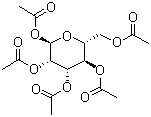
Alpha-D-Mannose pentaacetate is the fully acetylated derivative of alpha-D-mannopyranose in which the hydroxyl groups at positions 1, 2, 3, 4, and 6 are converted into acetate esters. D-mannose was identified in the nineteenth century during investigations of plant-derived carbohydrates and was recognized as an aldohexose closely related to D-glucose. Its structural differentiation from glucose, particularly the configuration at the C-2 position, was established through classical chemical transformations including oxidation, reduction, and formation of characteristic derivatives. The cyclic pyranose form of D-mannose and the existence of alpha and beta anomers were confirmed through mutarotation studies and isolation of crystalline derivatives.
The preparation of peracetylated sugars such as alpha-D-mannose pentaacetate became an essential technique in early carbohydrate chemistry. Treatment of D-mannose with acetic anhydride in the presence of basic catalysts such as pyridine converts all hydroxyl groups into acetate esters. Under controlled conditions, the alpha anomer of the pentaacetate can be obtained as a distinct crystalline compound. The ability to isolate and characterize separate alpha and beta acetates provided experimental confirmation of anomeric configuration and supported the cyclic hemiacetal structure proposed for hexoses.
Peracetylation offered significant practical advantages. Native monosaccharides are highly polar, strongly hydrogen bonded, and often difficult to crystallize. Conversion to acetate esters reduces intermolecular hydrogen bonding and increases solubility in organic solvents such as chloroform and dichloromethane. The resulting derivatives display well-defined melting points and optical rotations, properties that were crucial for structural comparison before the development of modern spectroscopic methods. Alpha-D-mannose pentaacetate thus contributed to the consolidation of stereochemical assignments within the hexose series.
Beyond structural studies, alpha-D-mannose pentaacetate has served as an important intermediate in synthetic carbohydrate chemistry. The acetyl groups function as protecting groups, temporarily masking hydroxyl reactivity during multistep reactions. Activation of the anomeric acetate under appropriate conditions allows the compound to participate in glycosylation reactions, forming glycosidic linkages with alcohols or other nucleophiles. Such transformations have been used in the preparation of mannose-containing glycosides and oligosaccharides relevant to biological research.
Experimental investigations of mannose derivatives have also advanced understanding of stereochemical control in glycosylation reactions. The acetyl substituent at the C-2 position influences reaction pathways through well-documented electronic and neighboring group effects, affecting the formation of intermediates and the configuration of products. Observations derived from reactions of peracetylated mannose derivatives have informed the development of synthetic strategies for constructing defined carbohydrate linkages.
In addition, acetylated mannose derivatives have been employed in studies of carbohydrate–protein interactions and in the preparation of building blocks for glycoconjugate synthesis. Controlled deacetylation under acidic or basic conditions regenerates hydroxyl groups at selected stages of synthesis, enabling further functionalization. The predictable stability and removal of acetyl protecting groups have made such derivatives reliable tools in laboratory practice.
Although alpha-D-mannose pentaacetate is primarily used as a research intermediate rather than as a final commercial product, its preparation and applications are firmly established in the literature. Through its role in confirming stereochemical relationships among hexoses and enabling controlled synthetic transformations, it exemplifies the experimentally documented importance of protected sugar derivatives in the advancement of carbohydrate chemistry.
References
2021. Tobramycin-loaded complexes to prevent and disrupt Pseudomonas aeruginosa biofilms. Drug Delivery and Translational Research.
DOI: 10.1007/s13346-021-01085-3
|





 GHS07 Warning Details
 Discovory and Applicatios