
Online Database of Chemicals from Around the World
| Hangzhou Verychem Science And Technology Co., Ltd. | China | Inquire | ||
|---|---|---|---|---|
 |
+86 (571) 8816-2785 +86 13606544505 | |||
 |
lucy@verychem.com | |||
| Chemical manufacturer since 2004 | ||||
| chemBlink massive supplier since 2021 | ||||
| Shanghai Xianhui Pharmaceutical Co., Ltd. | China | Inquire | ||
|---|---|---|---|---|
|
+86 (21) 6779-2654 +86 13564796979 | |||
|
shxh2006@outlook.com shxh2006@aliyun.com | |||
| Chemical manufacturer | ||||
| chemBlink standard supplier since 2008 | ||||
| Hefei TNJ Chemical Industry Co., Ltd. | China | Inquire | ||
|---|---|---|---|---|
|
+86 (551) 6541-8684 | |||
|
sales@tnjchem.com | |||
| Chemical manufacturer since 2001 | ||||
| chemBlink standard supplier since 2010 | ||||
| BOC Sciences | USA | Inquire | ||
|---|---|---|---|---|
|
+1 (631) 485-4226 | |||
|
info@bocsci.com | |||
| Chemical manufacturer | ||||
| chemBlink standard supplier since 2010 | ||||
| Hangzhou Leap Chem Co., Ltd. | China | Inquire | ||
|---|---|---|---|---|
|
+86 (571) 8771-1850 | |||
|
market19@leapchem.com | |||
 |
QQ chat | |||
| Chemical manufacturer since 2006 | ||||
| chemBlink standard supplier since 2015 | ||||
| Hangzhou Hairui Chemical Co., Ltd. | China | Inquire | ||
|---|---|---|---|---|
|
+86 (571) 8669-1155 | |||
|
sales@hairuichem.com | |||
| Chemical distributor since 2005 | ||||
| chemBlink standard supplier since 2017 | ||||
| Chengdu Aslee Biopharmaceuticals, Inc. | China | Inquire | ||
|---|---|---|---|---|
|
+86 (28) 8530-5008 +86 15102825326 | |||
|
may.yang@asleechem.com | |||
 |
Skype Chat | |||
|
QQ chat | |||
| Chemical manufacturer since 2013 | ||||
| chemBlink standard supplier since 2020 | ||||
| Frontier Specialty Chemicals | USA | Inquire | ||
|---|---|---|---|---|
|
+1 (435) 753-1901 | |||
|
sales@frontierspecialtychemicals.com | |||
| Chemical manufacturer since 1975 | ||||
| Classification | Organic raw materials >> Heterocyclic compound >> Pyrroles |
|---|---|
| Name | Chlorin E6 |
| Synonyms | (2S-trans)-18-Carboxy-20-(carboxymethyl)-13-ethyl-2,3-dihydro-3,7,12,17-tetramethyl-8-vinyl-21H,23H-porphine-2-propionic acid |
| Molecular Structure | 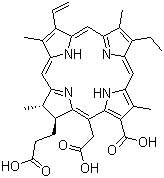 |
| Molecular Formula | C34H36N4O6 |
| Molecular Weight | 596.67 |
| CAS Registry Number | 19660-77-6 |
| EC Number | 243-209-4 |
| SMILES | CCC1=C(C2=CC3=C(C(=C(N3)C=C4[C@H]([C@@H](C(=N4)C(=C5C(=C(C(=N5)C=C1N2)C)C(=O)O)CC(=O)O)CCC(=O)O)C)C)C=C)C |
| Density | 1.3±0.1 g/cm3, Calc.* |
|---|---|
| Index of Refraction | 1.643, Calc.* |
| Boiling Point | 1048.3±65.0 ºC (760 mmHg), Calc.* |
| Flash Point | 587.8±34.3 ºC, Calc.* |
| * | Calculated using Advanced Chemistry Development (ACD/Labs) Software. |
| Hazard Symbols |
 GHS07 Warning Details
 | ||||||||||||||||||||
|---|---|---|---|---|---|---|---|---|---|---|---|---|---|---|---|---|---|---|---|---|---|
| Hazard Statements | H315-H319-H335 Details | ||||||||||||||||||||
| Precautionary Statements | P261-P264-P264+P265-P271-P280-P302+P352-P304+P340-P305+P351+P338-P319-P321-P332+P317-P337+P317-P362+P364-P403+P233-P405-P501 Details | ||||||||||||||||||||
| Hazard Classification | |||||||||||||||||||||
| |||||||||||||||||||||
| SDS | Available | ||||||||||||||||||||
 Discovory and Applicatios
|
Chlorin E6 is a chlorophyll derivative that has gained significant attention for its applications in photodynamic therapy, fluorescence imaging, and environmental remediation. Structurally, it belongs to the class of chlorins, which are tetrapyrrolic macrocycles with strong absorption in the red and near-infrared regions of the spectrum. This property makes it highly effective in biomedical applications where light activation is required. Chlorin E6 is known for its ability to generate reactive oxygen species upon light irradiation, leading to targeted therapeutic effects in cancer treatment and antimicrobial applications. The discovery of Chlorin E6 can be traced to studies on natural chlorophyll degradation products. Researchers first identified it as an intermediate in the breakdown of chlorophyll a, a process that occurs naturally in plants and algae. Its isolation and structural characterization were achieved using chromatographic and spectroscopic techniques such as high-performance liquid chromatography (HPLC), nuclear magnetic resonance (NMR), and mass spectrometry (MS). Early investigations focused on its photophysical properties, revealing its potential for medical and environmental applications. One of the most notable applications of Chlorin E6 is in photodynamic therapy (PDT), where it serves as a photosensitizer for cancer treatment. Upon exposure to specific wavelengths of light, Chlorin E6 undergoes a photochemical reaction that produces singlet oxygen, a highly reactive species capable of inducing cell death. This mechanism is particularly effective against tumors, as the photosensitizer can be selectively localized in cancerous tissues while minimizing damage to surrounding healthy cells. Clinical research has demonstrated the efficacy of Chlorin E6-based PDT in treating various cancers, including skin, lung, and esophageal malignancies. In addition to cancer therapy, Chlorin E6 has been explored for antimicrobial photodynamic applications. Its ability to generate reactive oxygen species under light exposure makes it effective against a wide range of bacterial and fungal pathogens. This property has led to its use in antimicrobial coatings and wound healing treatments where localized infections can be controlled using light-activated therapy. Studies have shown that Chlorin E6-based photodynamic treatment can reduce microbial resistance, offering an alternative to conventional antibiotics. Chlorin E6 also plays a role in fluorescence imaging and diagnostics. Its strong fluorescence in the red and near-infrared regions allows for deep tissue penetration, making it a valuable tool in medical imaging. Researchers have utilized Chlorin E6 derivatives as contrast agents for optical imaging techniques, enabling the visualization of tumors and other pathological conditions with high specificity. This application enhances the precision of medical diagnostics and improves treatment monitoring. Beyond biomedical uses, Chlorin E6 has been investigated for environmental applications, particularly in water purification. Its photochemical properties enable the degradation of organic pollutants when exposed to light, making it a promising candidate for photocatalytic water treatment. Studies have demonstrated its effectiveness in breaking down dyes, pharmaceuticals, and other contaminants, contributing to sustainable environmental remediation efforts. Despite its broad applications, challenges remain in optimizing the formulation and delivery of Chlorin E6 for therapeutic use. Its solubility, stability, and biodistribution require careful modification to enhance its clinical performance. Researchers continue to explore novel drug delivery systems, such as nanoparticles and liposomes, to improve its bioavailability and targeting efficiency. In summary, Chlorin E6 is a versatile compound with significant contributions to photodynamic therapy, antimicrobial treatments, medical imaging, and environmental science. Its unique photophysical properties and ability to generate reactive oxygen species have made it an essential molecule in both research and clinical applications. Ongoing studies aim to further refine its uses, ensuring its continued impact in diverse scientific fields. References 2024. Combined use of 5-ALA-induced protoporphyrin IX and chlorin e6 for fluorescence diagnostics and photodynamic therapy of skin tumors. Lasers in Medical Science, 39(1). DOI: 10.1007/s10103-024-04219-4 2024. Rationally designed porous self-assembled nanoparticles for combinational chemo-photodynamic therapy. Dalton transactions (Cambridge, England : 2003), 53(43). DOI: 10.1039/d4dt02454k 2024. Reactive oxygen species augmented polydopamine-chlorin e6 nanosystem for enhanced chemo/photothermal/photodynamic therapy: A synergistic trimodal combination approach in vitro & in vivo. International Journal of Biological Macromolecules, 283. DOI: 10.1016/j.ijbiomac.2024.137236 |
| Market Analysis Reports |
| List of Reports Available for Chlorin E6 |