
Online Database of Chemicals from Around the World
| Chengdu King-tiger Pharm-chem. Tech. Co., Ltd. | China | |||
|---|---|---|---|---|
 | www.king-tiger.com | |||
 | +86 (28) 8531-7716 +86 13880973897 | |||
 | +86 (28) 8531-7710 | |||
 | sales@king-tiger.com kingtigerpharm@gmail.com | |||
 | QQ Chat | |||
| Chemical manufacturer | ||||
| chemBlink Standard supplier since 2007 | ||||
| Simagchem Corporation | China | |||
|---|---|---|---|---|
| www.simagchem.com | |||
| +86 13806087780 | |||
| +86 (592) 268-0237 | |||
| sale@simagchem.com | |||
| Chemical manufacturer since 2002 | ||||
| chemBlink Standard supplier since 2008 | ||||
| Chengdu Cogon Bio-tech Co., Ltd. | China | |||
|---|---|---|---|---|
| www.cogonag4.com | |||
| +86 (28) 8517-1192 | |||
| +86 (28) 8517-1192 | |||
| cogon@cogonag4.com cogon_chem@hotmail.com | |||
| QQ Chat | |||
| Chemical manufacturer | ||||
| chemBlink Standard supplier since 2008 | ||||
| Wilshire Technologies, Inc. | USA | |||
|---|---|---|---|---|
| www.wilshiretechnologies.com | |||
| +1 (609) 683-1117 | |||
| +1 (732) 274-0049 | |||
| Wilshire-info@evonik.com | |||
| Chemical manufacturer since 1997 | ||||
| chemBlink Standard supplier since 2010 | ||||
| BOC Sciences | USA | |||
|---|---|---|---|---|
| www.bocsci.com | |||
| +1 (631) 485-4226 | |||
| +1 (631) 614-7828 | |||
| info@bocsci.com | |||
| Chemical manufacturer | ||||
| chemBlink Standard supplier since 2010 | ||||
| Chengdu Tianyuan Natural Product Co., Ltd. | China | |||
|---|---|---|---|---|
| www.cdtytr.com | |||
| +86 (28) 8501-2281 +86 13808177790 | |||
| +86 (28) 8512-1102 | |||
| xianlihong8888@163.com | |||
| QQ Chat | |||
| Chemical manufacturer since 2002 | ||||
| chemBlink Standard supplier since 2011 | ||||
| Aktin Chemicals Inc | China | |||
|---|---|---|---|---|
| www.aktinchem.com | |||
| +86 400-028-7725 | |||
| +86 (28) 8515-2372 | |||
| info@aktinchem.com | |||
| QQ Chat | |||
| Chemical manufacturer | ||||
| chemBlink Standard supplier since 2011 | ||||
| Intatrade Chemicals GmbH | Germany | |||
|---|---|---|---|---|
| www.intatrade.de | |||
| +49 (3493) 605-465 | |||
| +49 (3493) 605-470 | |||
| sales@intatrade.de | |||
| Chemical distributor | ||||
| chemBlink Standard supplier since 2011 | ||||
| Zhejiang Shengshi Biological Technology Co., Ltd. | China | |||
|---|---|---|---|---|
| www.gegejian.com | |||
| +86 (572) 501-8328 | |||
| +86 (572) 501-8191 | |||
| jj1002@163.com | |||
| Chemical manufacturer since 1998 | ||||
| chemBlink Standard supplier since 2013 | ||||
| NetQem, LLC | USA | |||
|---|---|---|---|---|
| www.netqem.us | |||
| +1 (919) 544-4122 | |||
| +1 (919) 544-4109 | |||
| sales@netqem.us | |||
| Chemical distributor since 2013 | ||||
| chemBlink Standard supplier since 2014 | ||||
| Labseeker Inc | USA | |||
|---|---|---|---|---|
| www.labseeker.com | |||
| +1 (858) 750-1632 | |||
| +1 (858) 412-1220 | |||
| marketing@labseeker.com | |||
| Chemical manufacturer since 2002 | ||||
| chemBlink Standard supplier since 2015 | ||||
| LEAPChem | China | |||
|---|---|---|---|---|
| www.leapchem.com | |||
| +86 (571) 8771-1850 | |||
| market19@leapchem.com | |||
| QQ Chat | |||
| Chemical manufacturer since 2006 | ||||
| chemBlink Standard supplier since 2015 | ||||
| Chengdu Biopurify Phytochemicals Ltd. | China | |||
|---|---|---|---|---|
| www.phytopurify.com | |||
| +86 (28) 8263-3860 8263-3987 | |||
| +86 (28) 8263-3165 | |||
| sales@biopurify.com biopurify@gmail.com | |||
| QQ Chat | |||
 | Skype Chat | |||
| Chemical manufacturer | ||||
| chemBlink Standard supplier since 2017 | ||||
| Xi'an Tianzi Biotechnology Co., Ltd. | China | |||
|---|---|---|---|---|
| www.tianzibio.com | |||
| +86 (29) 8161-1050 | |||
| +86 (29) 8161-1050 | |||
| sales@tianzibio.com | |||
| Chemical distributor since 2016 | ||||
| chemBlink Standard supplier since 2018 | ||||
| Neostar United (Changzhou) Industrial Co., Ltd. | China | |||
|---|---|---|---|---|
| www.neostarunited.com | |||
| +86 (519) 8555-7386 +86 18015025600 | |||
| +86 (519) 8555-7389 | |||
| marketing1@neostarunited.com | |||
| Chemical distributor since 2014 | ||||
| chemBlink Standard supplier since 2020 | ||||
| Shaanxi click biotechnology co., Ltd | China | |||
|---|---|---|---|---|
| www.herbchemical.com | |||
| +86 18629008060 | |||
| anna@herbchemical.com | |||
| QQ Chat | |||
| Chemical distributor since 2019 | ||||
| chemBlink Standard supplier since 2021 | ||||
| Cfm Oskar Tropitzsch GmbH | Germany | |||
|---|---|---|---|---|
| www.cfmot.de | |||
| +49 (9231) 9619-0 | |||
| +49 (9231) 9619-60 | |||
| info@cfmot.de | |||
| Chemical distributor since 1985 | ||||
| chemBlink Standard supplier since 2022 | ||||
| Chengdu Herbpurify Co., Ltd. | China | |||
|---|---|---|---|---|
| www.scstandards.com | |||
| +86 028 8265-1368 | |||
| 2851037747@qq.com | |||
| QQ Chat | |||
 | WeChat: 18981950076 | |||
| Chemical manufacturer since 2019 | ||||
| chemBlink Standard supplier since 2026 | ||||
| Sinova Corporation | USA | |||
|---|---|---|---|---|
| www.sinovainc.com | |||
| +1 (301) 961-1525 | |||
| +1 (240) 235-4288 | |||
| sales@sinovainc.com | |||
| Chemical manufacturer | ||||
| Dalton Pharma Services | Canada | |||
|---|---|---|---|---|
| www.dalton.com | |||
| +1 (416) 661-2102 | |||
| +1 (416) 661-2108 | |||
| chemist@dalton.com | |||
| Chemical manufacturer | ||||
| Ivy Fine Chemicals | USA | |||
|---|---|---|---|---|
| www.ivychem.com | |||
| +1 (856) 465-8550 | |||
| +1 (856) 616-1161 | |||
| sales@ivychem.com | |||
| Chemical manufacturer | ||||
| Classification | Biochemical >> Chinese herbal medicine ingredients |
|---|---|
| Name | Astragaloside IV |
| Molecular Structure | 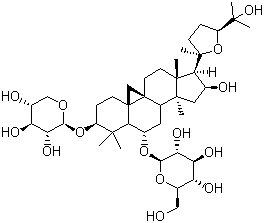 |
| Molecular Formula | C41H68O14 |
| Molecular Weight | 784.97 |
| CAS Registry Number | 84687-43-4 |
| SMILES | C[C@]12CC[C@@]34C[C@@]35CC[C@@H](C([C@@H]5[C@H](C[C@H]4[C@@]1(C[C@@H]([C@@H]2[C@]6(CC[C@H](O6)C(C)(C)O)C)O)C)O[C@H]7[C@@H]([C@H]([C@@H]([C@H](O7)CO)O)O)O)(C)C)O[C@H]8[C@@H]([C@H]([C@@H](CO8)O)O)O |
| Density | 1.4±0.1 g/cm3 Calc.* |
|---|---|
| Melting point | 295 - 296 °C (Expl.) |
| Boiling point | 895.7±65.0 °C 760 mmHg (Calc.)* |
| Flash point | 495.5±34.3 °C (Calc.)* |
| Index of refraction | 1.621 (Calc.)* |
| * | Calculated using Advanced Chemistry Development (ACD/Labs) Software. |
| Hazard Symbols |  GHS07 Warning Details |
|---|---|
| Risk Statements | H315-H319-H335 Details |
| Safety Statements | P261-P305+P351+P338 Details |
| SDS | Available |
 chemBlink Chemical Story
|
Astragaloside IV is a naturally occurring saponin glycoside belonging to the class of cycloartane-type triterpenoid saponins. It is one of the principal bioactive constituents isolated from the roots of *Astragalus membranaceus*, a medicinal plant widely used in traditional East Asian herbal medicine. Structurally, astragaloside IV consists of a cycloartane triterpene aglycone linked to sugar moieties through glycosidic bonds. The aglycone portion is a highly oxygenated tetracyclic triterpenoid framework, while the glycosidic chains typically include glucose and other monosaccharide units. This amphiphilic structure, combining a hydrophobic steroid-like core with hydrophilic sugar residues, is characteristic of saponins and is responsible for their surfactant-like properties. Saponins such as astragaloside IV are known for their ability to interact with biological membranes due to their dual hydrophilic–hydrophobic nature. The hydrophobic triterpene portion can associate with lipid bilayers, while the sugar chains interact with aqueous environments. This allows astragaloside IV to modulate membrane permeability and influence cell signaling processes. Astragaloside IV has been widely studied for its pharmacological activities, which include immunomodulatory, anti-inflammatory, antioxidant, and cardioprotective effects. These biological actions are mediated through multiple signaling pathways rather than a single molecular target, reflecting the complex nature of natural product pharmacology. One of the key mechanisms associated with astragaloside IV is modulation of inflammatory signaling pathways such as NF-κB and MAPK. By inhibiting activation of these pathways, it can reduce the expression of pro-inflammatory cytokines. This contributes to its observed anti-inflammatory effects in experimental models. Astragaloside IV has also been investigated for its effects on cardiovascular and metabolic systems. It is reported to improve endothelial function, reduce oxidative stress, and support myocardial protection under conditions of ischemia-reperfusion injury. These effects are thought to involve enhancement of nitric oxide signaling and reduction of reactive oxygen species. In addition, astragaloside IV has been studied for potential effects on aging-related processes. Some research suggests it may influence telomerase activity, cellular senescence pathways, and mitochondrial function, although these mechanisms are still under active investigation and not fully established in clinical contexts. From a physicochemical perspective, astragaloside IV is a large, highly oxygenated molecule with relatively low water solubility despite the presence of multiple sugar units. Its amphiphilic nature allows limited interaction with both aqueous and lipid environments, but its size and polarity generally restrict passive diffusion across biological membranes, meaning absorption and bioavailability are relatively low. As a glycoside, astragaloside IV can undergo enzymatic hydrolysis in biological systems, potentially yielding the corresponding aglycone and sugar residues. These metabolic transformations can influence its bioactivity and pharmacokinetic behavior. In traditional herbal preparations, astragaloside IV is part of a complex mixture of saponins, flavonoids, and polysaccharides that collectively contribute to the therapeutic effects attributed to *Astragalus* root. Modern pharmacological studies often aim to isolate astragaloside IV to understand its specific contributions within this mixture. Overall, astragaloside IV is a cycloartane-type triterpenoid saponin characterized by a hydrophobic steroid-like core and hydrophilic sugar chains. Its significance lies in its broad range of reported biological activities, particularly in immune regulation, inflammation modulation, and cardiovascular protection, making it an important natural product of pharmacological interest. References 2026. The LOTUS Initiative for Open Natural Products Research: frozen dataset union wikidata (with metadata). . DOI: 10.5281/zenodo.5794106 2023. Characterization and structure-based protein engineering of a regiospecific saponin acetyltransferase from Astragalus membranaceus. Nature Communications. URL: https://www.ncbi.nlm.nih.gov/pmc/articles/PMC10519980 2023. Perspectives on the current antiviral developments towards RNA-dependent RNA polymerase (RdRp) and methyltransferase (MTase) domains of dengue virus non-structural protein 5 (DENV-NS5). European Journal of Medicinal Chemistry. DOI: 10.1016/j.ejmech.2023.115416 |
| Market Analysis Reports |