
Online Database of Chemicals from Around the World
| Simagchem Corporation | China | |||
|---|---|---|---|---|
 | www.simagchem.com | |||
 | +86 13806087780 | |||
 | +86 (592) 268-0237 | |||
 | sale@simagchem.com | |||
| Chemical manufacturer since 2002 | ||||
| chemBlink Standard supplier since 2008 | ||||
| BOC Sciences | USA | |||
|---|---|---|---|---|
| www.bocsci.com | |||
| +1 (631) 485-4226 | |||
| +1 (631) 614-7828 | |||
| info@bocsci.com | |||
| Chemical manufacturer | ||||
| chemBlink Standard supplier since 2010 | ||||
| Zhangjiagang Clent Chemical Co., Ltd. | China | |||
|---|---|---|---|---|
| www.clentchem.com | |||
| +86 (512) 5881-3106 +86 13962460297 | |||
| +86 (512) 5881-2106 | |||
| sales@clentchem.com | |||
 | QQ Chat | |||
| Chemical manufacturer | ||||
| chemBlink Standard supplier since 2012 | ||||
| Qingdao Xinnuo Pharmaceutical Chemical Co., Ltd. | China | |||
|---|---|---|---|---|
| www.xinnuopharma.com | |||
| +86 (531) 6656-1050 +86 18615688656 +86 18653156686 | |||
| +86 (531) 6656-1050 | |||
| sales@xinnuopharma.com | |||
| QQ Chat | |||
 | Skype Chat | |||
| Chemical manufacturer since 2013 | ||||
| chemBlink Standard supplier since 2014 | ||||
| Medilink Pharmachem | India | |||
|---|---|---|---|---|
| www.medilinkpharma.com | |||
| +91 (79) 3007-0133 | |||
| +91 (79) 4007-4175 | |||
| exports@medilinkpharma.com | |||
| Chemical distributor since 1996 | ||||
| chemBlink Standard supplier since 2014 | ||||
| Hangzhou Leap Chem Co., Ltd. | China | |||
|---|---|---|---|---|
| www.leapchem.com | |||
| +86 (571) 8771-1850 | |||
| market19@leapchem.com | |||
| QQ Chat | |||
| Chemical manufacturer since 2006 | ||||
| chemBlink Standard supplier since 2015 | ||||
| Lengshi Chemical (Qingzhou) Co., Ltd. | China | |||
|---|---|---|---|---|
| www.xinnuopharma.cn | |||
| +86 18615688656 | |||
| sales@xinnuopharma.com | |||
 | WeChat: 18615688656 | |||
| Chemical distributor since 2024 | ||||
| chemBlink Standard supplier since 2026 | ||||
| Toronto Research Chemicals Inc. | Canada | |||
|---|---|---|---|---|
| www.trc-canada.com | |||
| +1 (416) 665-9696 | |||
| +1 (416) 665-4439 | |||
| info@trc-canada.com | |||
| Chemical manufacturer since 1982 | ||||
| Classification | Analytical chemistry >> Standard >> Pharmacopoeia standards and magazine standards |
|---|---|
| Name | Cyclobenzaprine hydrochloride |
| Synonyms | 5-(3-Dimethylaminopropylidene)dibenzo[a,e]cycloheptatriene hydrochloride |
| Molecular Structure | 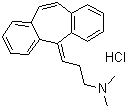 |
| Molecular Formula | C20H21N.HCl |
| Molecular Weight | 311.85 |
| CAS Registry Number | 6202-23-9 |
| EC Number | 228-264-4 |
| SMILES | CN(C)CCC=C1C2=CC=CC=C2C=CC3=CC=CC=C31.Cl |
| ethanol:50 mg/ml | |
|---|---|
| Hazard Symbols |   GHS06;GHS07 Danger Details GHS06;GHS07 Danger Details | ||||||||||||||||||||||||||||||||||||||||||||||||||||
|---|---|---|---|---|---|---|---|---|---|---|---|---|---|---|---|---|---|---|---|---|---|---|---|---|---|---|---|---|---|---|---|---|---|---|---|---|---|---|---|---|---|---|---|---|---|---|---|---|---|---|---|---|---|
| Risk Statements | H301-H312-H317-H332 Details | ||||||||||||||||||||||||||||||||||||||||||||||||||||
| Safety Statements | P261-P264-P270-P271-P272-P280-P301+P316-P302+P352-P304+P340-P317-P321-P330-P333+P317-P362+P364-P405-P501 Details | ||||||||||||||||||||||||||||||||||||||||||||||||||||
| Hazard Classification | |||||||||||||||||||||||||||||||||||||||||||||||||||||
| |||||||||||||||||||||||||||||||||||||||||||||||||||||
| SDS | Available | ||||||||||||||||||||||||||||||||||||||||||||||||||||
 chemBlink Chemical Story
|
Cyclobenzaprine hydrochloride is the hydrochloride salt of cyclobenzaprine, a centrally acting skeletal muscle relaxant used primarily for the short-term treatment of muscle spasms associated with acute musculoskeletal conditions. It is structurally related to tricyclic antidepressants and shares a similar tricyclic core framework, although its pharmacological use is distinct. Cyclobenzaprine contains a tricyclic dibenzocycloheptene-like scaffold with a tertiary amine side chain. This structural similarity to tricyclic antidepressants is reflected in its interaction with central nervous system pathways, although its primary therapeutic effect is muscle relaxation rather than mood modulation. The hydrochloride salt form increases the compound’s stability and water solubility, making it suitable for oral pharmaceutical formulations. The mechanism of action of cyclobenzaprine is not fully understood in precise molecular terms, but it is known to act within the central nervous system, particularly at the brainstem level. It is believed to reduce tonic somatic motor activity by influencing descending motor pathways, thereby decreasing alpha and gamma motor neuron activity. This results in a reduction of skeletal muscle hyperactivity and associated spasms without directly acting on skeletal muscle fibers or the neuromuscular junction. Cyclobenzaprine does not function as a direct muscle relaxant in peripheral tissues; instead, its effects are mediated through central sedative and antispasmodic actions. Its pharmacological profile includes interactions with serotonergic and noradrenergic systems, as well as affinity for certain central receptors, although it is not classified as a selective receptor agonist or antagonist in these pathways. From a structural perspective, cyclobenzaprine contains a rigid tricyclic ring system that constrains the orientation of its side chain. This rigid structure influences its binding to central nervous system targets and contributes to its pharmacokinetic properties. The tertiary amine group in the side chain is protonated under physiological conditions, making the hydrochloride salt form particularly relevant for formulation and absorption. Cyclobenzaprine hydrochloride is typically administered orally and undergoes hepatic metabolism, primarily through oxidative pathways involving cytochrome P450 enzymes. Its metabolites are excreted via renal and fecal routes. The drug has a relatively long elimination half-life, which contributes to sustained pharmacological effects but also necessitates caution in dosing to avoid accumulation. Clinically, cyclobenzaprine is used as an adjunct to rest and physical therapy in the management of acute muscle spasms. It is not intended for long-term use, as its efficacy is generally limited to short-term symptom relief. Its sedative properties are also clinically relevant and can contribute to drowsiness, which is a common pharmacological effect associated with central nervous system depressants. The hydrochloride salt form is important for pharmaceutical stability and formulation. Conversion to a salt improves solubility in aqueous environments, allowing consistent absorption in the gastrointestinal tract. Many amine-containing drugs are formulated as hydrochloride salts for this reason. Overall, cyclobenzaprine hydrochloride is a centrally acting skeletal muscle relaxant with a tricyclic structure, functioning primarily through central modulation of motor pathways. Its significance lies in its clinical use for acute muscle spasm relief and its pharmacological relationship to tricyclic compounds affecting the central nervous system. References 2026. Current evidence on TNX-102 SL (cyclobenzaprine HCl sublingual) for fibromyalgia: strengths, limitations, and emerging hypotheses. Clinical Rheumatology. DOI: 10.1007/s10067-025-07903-0 2025. Sublingual Cyclobenzaprine: First Approval. Clinical Drug Investigation. DOI: 10.1007/s40261-025-01512-0 |
| Market Analysis Reports |