
Online Database of Chemicals from Around the World
| Guangzhou Choe Chemicals Co., Ltd. | China | |||
|---|---|---|---|---|
 | www.choe.cn | |||
 | +86 (20) 3223-1429 +86 13570063313 | |||
 | +86 (20) 3223-0261 | |||
 | public@choe.cn | |||
| Chemical manufacturer since 2002 | ||||
| chemBlink Standard supplier since 2007 | ||||
| Extrasynthese Chemical S.A.S. | France | |||
|---|---|---|---|---|
| www.extrasynthese.com | |||
| +33 (47) 898-2034 | |||
| +33 (47) 898-1945 | |||
| info@extrasynthese.com | |||
| Chemical manufacturer | ||||
| chemBlink Standard supplier since 2009 | ||||
| wuhan chemi Pharmacy Chemical Technology Co., Ltd. | China | |||
|---|---|---|---|---|
| www.chemipharm.com.cn | |||
| +86 13971619949 | |||
| gmn424@chemipharm.com.cn | |||
 | QQ Chat | |||
 | WeChat: 13971619949 | |||
| Chemical manufacturer since 2014 | ||||
| chemBlink Standard supplier since 2026 | ||||
| Pressure Chemical Company | USA | |||
|---|---|---|---|---|
| www.presschem.com | |||
| +1 (800) 722-5247 (412) 682-5882 | |||
| +1 (412) 682-5864 | |||
| contact_us@presschem.com | |||
| Chemical manufacturer since 1964 | ||||
| QV Chemicals LLC | USA | |||
|---|---|---|---|---|
| www.qvchemicals.com | |||
| +1 (636) 489-2021 | |||
| +1 (636) 284-2510 | |||
| info@qvchemicals.com | |||
| Chemical manufacturer | ||||
| Classification | Organic raw materials >> Amino compound >> Sulfonic acid amino compound |
|---|---|
| Name | Cholesteryl palmitate |
| Synonyms | 5-Cholestene 3-palmitate; Cholest-5-ene-3-beta-yl palmitate |
| Molecular Structure | 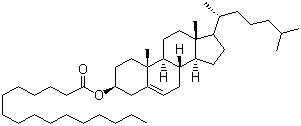 |
| Molecular Formula | C43H76O2 |
| Molecular Weight | 625.07 |
| CAS Registry Number | 601-34-3 |
| EC Number | 210-002-5 |
| SMILES | CCCCCCCCCCCCCCCC(=O)O[C@H]1CC[C@@]2([C@H]3CC[C@]4([C@H]([C@@H]3CC=C2C1)CC[C@@H]4[C@H](C)CCCC(C)C)C)C |
| Density | 1.0±0.1 g/cm3 Calc.* |
|---|---|
| Melting point | 74 - 77 °C (Expl.) |
| Boiling point | 651.5±34.0 °C 760 mmHg (Calc.)* |
| Flash point | 347.8±13.2 °C (Calc.)* |
| Index of refraction | 1.506 (Calc.)* |
| alpha | -24 ° (c=2, CHCl3 27 °C) |
| * | Calculated using Advanced Chemistry Development (ACD/Labs) Software. |
| Hazard Symbols |  GHS07 Warning Details GHS07 Warning Details |
|---|---|
| Risk Statements | H302-H315-H319-H335 Details |
| Safety Statements | P261-P305+P351+P338 Details |
| SDS | Available |
 chemBlink Chemical Story
|
Cholesteryl palmitate is a naturally occurring sterol ester composed of cholesterol and palmitic acid. It belongs to the broader class of cholesteryl esters, which are lipid storage and transport forms of cholesterol in biological systems. In this compound, the hydroxyl group of cholesterol is esterified with the carboxyl group of palmitic acid, a saturated long-chain fatty acid. Cholesterol is a tetracyclic sterol molecule that plays essential roles in biological membranes, where it modulates fluidity, permeability, and structural organization. It also serves as a precursor for steroid hormones, bile acids, and vitamin D. Palmitic acid, on the other hand, is a common saturated fatty acid widely distributed in animal and plant lipids. The esterification of these two molecules produces a highly hydrophobic compound with distinct physicochemical properties compared with free cholesterol. Cholesteryl palmitate is one of several cholesteryl esters formed in vivo through the action of enzymes such as lecithin–cholesterol acyltransferase (LCAT) in plasma and acyl-CoA:cholesterol acyltransferase (ACAT) in cells. These enzymes catalyze the transfer of fatty acyl groups to cholesterol, producing cholesteryl esters that are more hydrophobic than free cholesterol. This increased hydrophobicity allows cholesterol to be efficiently stored in lipid droplets or transported within lipoprotein particles. In human physiology, cholesteryl esters are major components of circulating lipoproteins such as low-density lipoprotein (LDL) and high-density lipoprotein (HDL). They serve as a storage and transport form of cholesterol, enabling the movement of cholesterol through the aqueous environment of blood plasma. Cholesteryl palmitate contributes to the overall composition of these lipid assemblies, although the specific fatty acid distribution can vary depending on metabolic conditions and diet. From a structural standpoint, cholesteryl palmitate consists of a rigid sterol nucleus derived from cholesterol, attached to a long flexible hydrocarbon chain from palmitic acid. This combination results in a highly lipophilic molecule with extremely low water solubility. The sterol ring system is largely planar and rigid, while the fatty acid chain provides conformational flexibility. The ester linkage between them is relatively stable under physiological conditions but can be hydrolyzed by esterases when mobilization of cholesterol is required. Cholesteryl esters, including cholesteryl palmitate, are stored in lipid droplets within cells. These lipid droplets serve as intracellular reservoirs of neutral lipids, including triacylglycerols and sterol esters. Mobilization of cholesteryl esters is catalyzed by cholesteryl ester hydrolases, which release free cholesterol and fatty acids for metabolic use, membrane synthesis, or steroidogenesis. The physical properties of cholesteryl palmitate are dominated by its hydrophobic nature. It is typically a waxy or solid lipid at physiological temperatures, with very low solubility in aqueous environments. Its melting behavior is influenced by the saturated nature of palmitic acid, which allows tight packing of lipid molecules and contributes to higher melting points compared with unsaturated cholesteryl esters. In biological and biomedical research, cholesteryl esters are studied for their roles in lipid metabolism, atherosclerosis, and membrane biology. Accumulation of cholesteryl esters in macrophages within arterial walls contributes to the formation of foam cells, a hallmark of early atherosclerotic lesions. While multiple cholesteryl esters are involved in this process, cholesteryl palmitate is one representative species among the diverse esterified cholesterol pool. From a biochemical perspective, the formation and hydrolysis of cholesteryl esters represent a key regulatory mechanism for maintaining cholesterol homeostasis. The balance between free and esterified cholesterol is tightly controlled, and disruptions in this balance are associated with metabolic disorders. Overall, cholesteryl palmitate is a highly hydrophobic sterol ester formed from cholesterol and palmitic acid. It functions primarily as a storage and transport form of cholesterol within biological lipid systems and contributes to the structural and metabolic roles of cholesteryl esters in cellular and systemic lipid homeostasis. References 2026. Analysis of intercellular lipids in the stratum corneum of patients with capecitabine-induced hand-foot syndrome: comparison with the stratum corneum of healthy individuals. Cancer Chemotherapy and Pharmacology. DOI: 10.1007/s00280-025-04842-0 2026. The LOTUS Initiative for Open Natural Products Research: frozen dataset union wikidata (with metadata). . DOI: 10.5281/zenodo.5794106 2025. Development of Panoramic Liquid-Crystal Methods for Visualizing Wall Flows at the Institute of Theoretical and Applied Mechanics SB RAS. Journal of Engineering Physics and Thermophysics. DOI: 10.1007/s10891-026-03262-y |
| Market Analysis Reports |