
Online Database of Chemicals from Around the World
| Glentham Life Sciences | UK | |||
|---|---|---|---|---|
 | www.glenthamls.com | |||
 | +44 (2033) 978-798 | |||
 | +44 (2033) 978-909 | |||
 | info@glenthamls.com | |||
| Chemical distributor since 2013 | ||||
| chemBlink Standard supplier since 2013 | ||||
| wuhan chemi Pharmacy Chemical Technology Co., Ltd. | China | |||
|---|---|---|---|---|
| www.chemipharm.com.cn | |||
| +86 13971619949 | |||
| gmn424@chemipharm.com.cn | |||
 | QQ Chat | |||
 | WeChat: 13971619949 | |||
| Chemical manufacturer since 2014 | ||||
| chemBlink Standard supplier since 2026 | ||||
| Anvia Chemicals, LLC | USA | |||
|---|---|---|---|---|
| www.anviachem.com | |||
| +1 (414) 534-7845 | |||
| +1 (414) 762-5539 | |||
| sales@anviachem.com | |||
| Chemical manufacturer | ||||
| Classification | Organic raw materials >> Carboxylic compounds and derivatives |
|---|---|
| Name | 4-Guanidinobutanoic acid |
| Synonyms | HL 6450; N-(4-Butanoic acid)guanidine; NSC 521717; gamma-Guanidinebutyric acid; gamma-Guanidinobutyric acid |
| Molecular Structure | 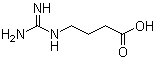 |
| Molecular Formula | C5H11N3O2 |
| Molecular Weight | 145.16 |
| CAS Registry Number | 463-00-3 |
| EC Number | 207-331-1 |
| SMILES | C(CC(=O)O)CN=C(N)N |
| Solubility | Freely soluble (267 g/L) (25 °C), Calc.* |
|---|---|
| Density | 1.37±0.1 g/cm3 (20 °C 760 Torr), Calc.* |
| Melting point | 280 - 282 °C (Expl.) |
| Boiling point | 322.2±44.0 °C 760 mmHg (Calc.)* |
| Flash point | 148.6±28.4 °C (Calc.)* |
| Index of refraction | 1.56 (Calc.)* |
| * | Calculated using Advanced Chemistry Development (ACD/Labs) Software. |
| Hazard Symbols |  GHS07 Warning Details GHS07 Warning Details | ||||||||||||||||
|---|---|---|---|---|---|---|---|---|---|---|---|---|---|---|---|---|---|
| Risk Statements | H315-H319-H335 Details | ||||||||||||||||
| Safety Statements | P261-P264-P264+P265-P271-P280-P302+P352-P304+P340-P305+P351+P338-P319-P321-P332+P317-P337+P317-P362+P364-P403+P233-P405-P501 Details | ||||||||||||||||
| Hazard Classification | |||||||||||||||||
| |||||||||||||||||
| SDS | Available | ||||||||||||||||
 chemBlink Chemical Story
|
4-Guanidinobutanoic acid is an organic compound consisting of a four-carbon aliphatic chain bearing a terminal carboxylic acid group and a guanidino functional group at the opposite end. It is structurally related to naturally occurring amino acid derivatives and can be viewed as a guanidine-substituted butyric acid. Compounds containing guanidino groups are of significant interest in biochemistry due to their strong basicity and frequent occurrence in biologically active molecules. The guanidino group is a highly basic functional group characterized by resonance stabilization of the positive charge when protonated. It consists of a central carbon atom bonded to three nitrogen atoms, allowing extensive delocalization of electron density. This delocalization results in a strongly basic center that is almost fully protonated under physiological pH conditions. As a result, 4-guanidinobutanoic acid typically exists in a zwitterionic or highly polar ionic form in aqueous environments. The carboxylic acid group at one end of the molecule provides an acidic site that can undergo deprotonation to form a carboxylate anion. The coexistence of a strongly basic guanidino group and an acidic carboxyl group gives the molecule amphoteric character, allowing it to exist in multiple ionic states depending on pH. In neutral aqueous solution, the compound is expected to predominantly exist as a zwitterion with a protonated guanidinium group and a deprotonated carboxylate group. From a structural perspective, the butanoic acid backbone provides flexibility due to free rotation around carbon–carbon single bonds. This flexibility allows the functional groups at each end of the molecule to adopt conformations that minimize electrostatic repulsion between charged sites. The spatial separation of functional groups also influences solubility and intermolecular interactions. The guanidino group is well known for its strong hydrogen-bonding ability, functioning as a multi-donor and resonance-stabilized cation. This property is exemplified in the amino acid arginine, which contains a similar guanidino side chain. Such groups are frequently involved in protein–ligand interactions, salt bridge formation, and enzyme active site stabilization due to their ability to form strong electrostatic and hydrogen-bonding interactions. In aqueous solution, 4-guanidinobutanoic acid is expected to be highly soluble due to its ionic nature. The combination of a carboxylate and a guanidinium group leads to strong interactions with water molecules through both electrostatic forces and hydrogen bonding networks. This high polarity generally precludes significant solubility in nonpolar organic solvents. The synthesis of guanidino-containing carboxylic acids is commonly achieved through guanidination reactions, where a primary amine precursor reacts with guanidinating agents such as O-methylisourea or similar reagents. In the case of 4-guanidinobutanoic acid, it can be conceptually derived from 4-aminobutanoic acid (GABA) through substitution of the amino group with a guanidino functionality. Biologically, guanidino compounds are widely distributed in metabolism and physiology. The structural similarity of 4-guanidinobutanoic acid to naturally occurring metabolites suggests potential relevance in biochemical pathways involving amino acid derivatives, although its specific biological role depends on context and organismal metabolism. Guanidino-containing compounds are often involved in nitrogen metabolism and cellular signaling due to their strong cationic nature. From a physicochemical standpoint, the compound is expected to exhibit high melting point behavior typical of ionic organic compounds, driven by strong intermolecular electrostatic interactions and hydrogen bonding. Its zwitterionic nature in physiological conditions contributes to crystallinity and aqueous stability. Overall, 4-guanidinobutanoic acid is a small, highly polar bifunctional molecule containing both a carboxylic acid and a guanidino group. Its significance lies in its strong acid–base duality, zwitterionic behavior, and structural relationship to biologically important guanidino compounds such as arginine, making it relevant in biochemical, synthetic, and medicinal chemistry contexts. References 2026. Characterizing Human Oxidative, Anabolic and Glycolytic Metabolism in Athletes with Extreme Physiologies. Sports Medicine - Open. URL: https://www.ncbi.nlm.nih.gov/pmc/articles/PMC12972380 |
| Market Analysis Reports |