
Online Database of Chemicals from Around the World
| Bio-sugars Technology Co., Ltd. | China | |||
|---|---|---|---|---|
 | www.bio-sugars.com | |||
 | +86 (579) 8901-8388 +86 15167971485 | |||
 | +86 (579) 8855-6787 | |||
 | syngars@hotmail.com | |||
 | QQ Chat | |||
| Chemical manufacturer since 2008 | ||||
| chemBlink Standard supplier since 2006 | ||||
| Beijing Ribio Biotech. Inc. | China | |||
|---|---|---|---|---|
| www.ribio.com.cn | |||
| +86 (10) 6266-4360 +86 13910960639 | |||
| +86 (10) 6266-4370 | |||
| sales@ribio.com.cn ribio@163.com | |||
| QQ Chat | |||
| Chemical manufacturer since 2007 | ||||
| chemBlink Standard supplier since 2007 | ||||
| Nanjing Search Biotech Co., Ltd. | China | |||
|---|---|---|---|---|
| www.searchbio.com.cn | |||
| +86 (25) 8168-2922 8586-0978 +86 18913919581 | |||
| +86 (25) 8586-0962 | |||
| trade@searchbio.com.cn sales@searchbio.com.cn Linda@searchbio.com.cn | |||
| QQ Chat | |||
| Chemical manufacturer since 2007 | ||||
| chemBlink Standard supplier since 2007 | ||||
| Zibo Feiyang Biotechnology Co., Ltd. | China | |||
|---|---|---|---|---|
| www.chemfy.com | |||
| +86 (533) 736-9098 | |||
| +86 (533) 736-9099 | |||
| sales@chemfy.com dudeliang@hotmail.com | |||
| Chemical manufacturer | ||||
| chemBlink Standard supplier since 2008 | ||||
| Simagchem Corporation | China | |||
|---|---|---|---|---|
| www.simagchem.com | |||
| +86 13806087780 | |||
| +86 (592) 268-0237 | |||
| sale@simagchem.com | |||
| Chemical manufacturer since 2002 | ||||
| chemBlink Standard supplier since 2008 | ||||
| Intatrade Chemicals GmbH | Germany | |||
|---|---|---|---|---|
| www.intatrade.de | |||
| +49 (3493) 605-465 | |||
| +49 (3493) 605-470 | |||
| sales@intatrade.de | |||
| Chemical distributor | ||||
| chemBlink Standard supplier since 2011 | ||||
| Biosynth AG. | Switzerland | |||
|---|---|---|---|---|
| www.biosynth.com | |||
| +41 (71) 858-2020 | |||
| +41 (71) 858-2030 | |||
| welcome@biosynth.ch | |||
| Chemical manufacturer | ||||
| chemBlink Standard supplier since 2014 | ||||
| Hangzhou Leap Chem Co., Ltd. | China | |||
|---|---|---|---|---|
| www.leapchem.com | |||
| +86 (571) 8771-1850 | |||
| market19@leapchem.com | |||
| QQ Chat | |||
| Chemical manufacturer since 2006 | ||||
| chemBlink Standard supplier since 2015 | ||||
| Carbosynth China Ltd. | China | |||
|---|---|---|---|---|
| www.carbosynth.cn | |||
| +86 (512) 6260-5585 | |||
| +86 (512) 6260-5576 | |||
| sales@carbosynth.com | |||
| QQ Chat | |||
| Chemical manufacturer since 2006 | ||||
| chemBlink Standard supplier since 2016 | ||||
| Xinxiang Aurora Biotechnology Co., Ltd. | China | |||
|---|---|---|---|---|
| www.aurora-biotech.com | |||
| +86 (373) 308-8722 +86 18637352520 | |||
| +86 (373) 308-8722 | |||
| info@aurora-biotech.com | |||
| QQ Chat | |||
 | Skype Chat | |||
| Chemical manufacturer since 2012 | ||||
| chemBlink Standard supplier since 2017 | ||||
| Hunan Yunbang Biomedical Co., Ltd. | China | |||
|---|---|---|---|---|
| www.hunanyunbang.com | |||
| +86 (731) 8552-5705 +86 13319518603 | |||
| +86 (731) 8552-5705 | |||
| ivy@hnhbsj.com | |||
| QQ Chat | |||
| Skype Chat | |||
| Chemical manufacturer since 2014 | ||||
| chemBlink Standard supplier since 2019 | ||||
| HuNan Huibaiyi New Materials Co; Ltd. | China | |||
|---|---|---|---|---|
| www.hbsjxcl.com | |||
| +86 13319523173 | |||
| ivy@hnhbsj.com | |||
| QQ Chat | |||
 | WeChat: 13319523173 | |||
| Chemical manufacturer since 2014 | ||||
| chemBlink Standard supplier since 2026 | ||||
| Chemos GmbH & Co. KG | Germany | |||
|---|---|---|---|---|
| www.chemos.de | |||
| +49 871-966346-0 | |||
| +49 871-966346-13 | |||
| chemos@chemos.de | |||
| Chemical distributor | ||||
| Indofine Chemical Company, Inc. | USA | |||
|---|---|---|---|---|
| www.indofinechemical.com | |||
| +1 (888) 463-6346 | |||
| +1 (908) 359-1179 | |||
| info@indofinechemical.com | |||
| Chemical manufacturer since 1981 | ||||
| BioVectra, Inc. | Canada | |||
|---|---|---|---|---|
| www.biovectra.com | |||
| +1 (902) 566-9116 (866) 883-2872 | |||
| +1 (902) 628-2045 | |||
| info@biovectra.com | |||
| Chemical manufacturer since 1970 | ||||
| Santa Cruz Biotechnology, Inc. | USA | |||
|---|---|---|---|---|
| www.scbt.com | |||
| +1 (831) 457-3800 | |||
| +1 (831) 457-3801 | |||
| scbt@scbt.com | |||
| Chemical manufacturer | ||||
| Avonchem/Chromos Express Ltd. | UK | |||
|---|---|---|---|---|
| www.avonchem.co.uk | |||
| +44 (1625) 434-300 | |||
| +44 (1625) 869-777 | |||
| info@avonchem.co.uk | |||
| Chemical manufacturer | ||||
| Melford Laboratories Limited | UK | |||
|---|---|---|---|---|
| www.melford.co.uk | |||
| +44 (1449) 741-178 | |||
| +44 (1449) 741-217 | |||
| pfranklin@melford.co.uk sales@melford.co.uk | |||
| Chemical manufacturer since 1985 | ||||
| Classification | Biochemical >> Carbohydrate >> Monosaccharide |
|---|---|
| Name | 2-Nitrophenyl-beta-D-galactopyranoside |
| Synonyms | ONPG |
| Molecular Structure | 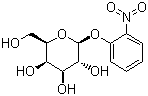 |
| Molecular Formula | C12H15NO8 |
| Molecular Weight | 301.25 |
| CAS Registry Number | 369-07-3 |
| EC Number | 206-716-1 |
| SMILES | C1=CC=C(C(=C1)[N+](=O)[O-])O[C@H]2[C@@H]([C@H]([C@H]([C@H](O2)CO)O)O)O |
| Density | 1.6±0.1 g/cm3 Calc.* |
|---|---|
| Melting point | 192 °C (Decomposes) (Expl.) |
| Boiling point | 572.4±50.0 °C 760 mmHg (Calc.)* |
| Flash point | 300.0±30.1 °C (Calc.)* |
| Index of refraction | 1.648 (Calc.)* |
| Alpha | -70 ° (c=1, H2O) (Expl.) |
| * | Calculated using Advanced Chemistry Development (ACD/Labs) Software. |
| Hazard Symbols |  GHS07 Warning Details GHS07 Warning Details | ||||||||||||||||
|---|---|---|---|---|---|---|---|---|---|---|---|---|---|---|---|---|---|
| Risk Statements | H315-H319-H335 Details | ||||||||||||||||
| Safety Statements | P261-P264-P264+P265-P271-P280-P302+P352-P304+P340-P305+P351+P338-P319-P321-P332+P317-P337+P317-P362+P364-P403+P233-P405-P501 Details | ||||||||||||||||
| Hazard Classification | |||||||||||||||||
| |||||||||||||||||
| SDS | Available | ||||||||||||||||
 chemBlink Chemical Story
|
2-Nitrophenyl-β-D-galactopyranoside is a synthetic glycoside composed of a β-D-galactopyranose sugar linked through a glycosidic oxygen bond to an ortho-nitrophenyl aglycone. It is widely used as a chromogenic substrate in biochemical assays for β-galactosidase activity, particularly in microbiology and molecular biology applications. Structurally, the molecule contains two principal components: a carbohydrate moiety derived from D-galactose and an aromatic nitrophenyl group. The galactopyranose unit is a six-membered ring sugar that predominantly adopts a stable chair conformation. It contains multiple hydroxyl groups arranged in a stereochemically defined pattern, which enables extensive hydrogen bonding with water and enzyme active sites. The glycosidic linkage is a β-linkage, meaning the substituent attached to the anomeric carbon (C1) of the sugar is oriented in the same stereochemical direction as the C5 substituent in the D-galactose configuration. This stereochemical arrangement is essential for recognition by β-galactosidase enzymes, which specifically hydrolyze β-linked galactosides while excluding most α-linked analogs. The aglycone portion is a 2-nitrophenyl group, consisting of a benzene ring substituted with a nitro group (–NO2) at the ortho position relative to the glycosidic oxygen. The nitro group is strongly electron-withdrawing through both inductive and resonance effects, which significantly influences the electronic distribution of the aromatic ring and the chromogenic properties of the compound after enzymatic cleavage. Upon enzymatic hydrolysis by β-galactosidase, the glycosidic bond is cleaved, releasing free 2-nitrophenol and D-galactose. The liberated 2-nitrophenol can undergo deprotonation under alkaline conditions to form the 2-nitrophenolate ion, which exhibits a yellow coloration due to extended conjugation and altered electron distribution within the aromatic system. This color change enables quantitative spectrophotometric measurement of enzyme activity. The galactopyranose portion is highly hydrophilic due to the presence of multiple hydroxyl groups, each capable of acting as hydrogen bond donors and acceptors. These groups contribute significantly to the solubility of the compound in aqueous media and also participate in binding interactions within the enzyme active site prior to hydrolysis. The aromatic nitrophenyl group provides hydrophobic character and acts as the chromogenic reporter moiety. The balance between the polar sugar portion and the aromatic aglycone results in an amphiphilic molecule suitable for aqueous biochemical assays. From a physicochemical standpoint, 2-nitrophenyl-β-D-galactopyranoside is highly water soluble and stable under neutral conditions. The glycosidic bond is resistant to spontaneous hydrolysis but is selectively cleaved by β-galactosidase, reflecting the enzyme’s substrate specificity for β-D-galactosides. Chemically, the most important transformation is enzymatic hydrolysis of the glycosidic linkage. The nitro substituent remains intact during cleavage but plays a key role in stabilizing the colored phenolate product formed after release. The resulting chromogenic signal is dependent on pH, since deprotonation enhances conjugation and visible light absorption. Overall, 2-nitrophenyl-β-D-galactopyranoside is a synthetic β-galactoside substrate composed of a galactose-derived sugar linked to an ortho-nitrophenyl group. Its structure is designed to enable enzymatic recognition by β-galactosidase and to generate a measurable colorimetric response upon hydrolysis, making it a widely used analytical reagent in biochemical research. References 2026. Cross-stress adaptation enhances the survival and stability of freeze-dried lactic acid bacteria. Food Science of Animal Resources. DOI: 10.1007/s44463-025-00007-y 2025. Development of a markerless tool for targeted chromosome modification in the thermophilic and methylotrophic bacterium Bacillus methanolicus. Microbial Cell Factories. DOI: 10.1186/s12934-025-02880-0 2025. Transcription factor with ambivalent role – Ralstonia eutropha’s PhaR is a repressor of the phasin-gene phaP1 and an activator of phaP3. BMC Microbiology. DOI: 10.1186/s12866-025-04628-7 |
| Market Analysis Reports |