
Online Database of Chemicals from Around the World
| Wuhan Kemi-works Chemical Co., Ltd. | China | |||
|---|---|---|---|---|
 | www.kemiworks.net | |||
 | +86 (27) 8573-6489 | |||
 | +86 (27) 8573-6485 | |||
 | info@kemiworks.net sales@kemiworks.com | |||
| Chemical manufacturer | ||||
| chemBlink Premium supplier since 2011 | ||||
| Classification | Chemical reagent >> Silane reagent |
|---|---|
| Name | 1,1,3,5,5-Pentaphenyl-1,3,5-trimethyltrisiloxane |
| Synonyms | 1,3,5-Trimethyl-1,1,3,5,5-pentaphenyltrisiloxane |
| Molecular Structure | 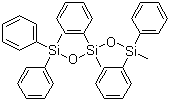 |
| Molecular Formula | C33H34O2Si3 |
| Molecular Weight | 546.88 |
| CAS Registry Number | 3390-61-2 |
| EC Number | 222-222-9 |
| SMILES | C[Si](C1=CC=CC=C1)(C2=CC=CC=C2)O[Si](C)(C3=CC=CC=C3)O[Si](C)(C4=CC=CC=C4)C5=CC=CC=C5 |
| Density | 1.1±0.1 g/cm3 Calc.* |
|---|---|
| Melting point | -25 °C (Expl.) |
| Boiling point | 560.2±33.0 °C 760 mmHg (Calc.)* |
| Flash point | 238.3±25.8 °C (Calc.)* |
| Solubility | water: insoluble (Expl.) |
| Index of refraction | 1.6 (Calc.)* |
| * | Calculated using Advanced Chemistry Development (ACD/Labs) Software. |
| Hazard Symbols |  GHS07 Warning Details GHS07 Warning Details | ||||||||
|---|---|---|---|---|---|---|---|---|---|
| Risk Statements | H319 Details | ||||||||
| Safety Statements | P264+P265-P280-P305+P351+P338-P337+P317 Details | ||||||||
| Hazard Classification | |||||||||
| |||||||||
| SDS | Available | ||||||||
 chemBlink Chemical Story
|
1,1,3,5,5-Pentaphenyl-1,3,5-trimethyltrisiloxane is an organosilicon compound belonging to the family of phenyl-substituted siloxanes. Although it is used primarily as a specialty intermediate and research material rather than as a large-volume commercial product, it represents one of the structural motifs that contributed to the development of high-performance silicone materials. Its scientific importance lies not in its individual applications but in the molecular design strategy it exemplifies: modifying the organic substituents attached to the siloxane backbone to tailor the physical and chemical properties of silicone materials. The development of organosilicon chemistry accelerated after World War II as silicone polymers found increasing use in aerospace, electronics, electrical insulation, and high-temperature engineering. Early commercial silicones consisted mainly of polydimethylsiloxane (PDMS), whose methyl-substituted siloxane chains provided excellent flexibility, low glass-transition temperatures, chemical inertness, and water repellency. These characteristics made PDMS an exceptionally versatile material, but they also imposed limitations in applications requiring higher thermal stability, improved radiation resistance, enhanced compatibility with aromatic polymers, or greater optical refractive index. To overcome these limitations, chemists explored systematic modification of the organic groups attached to silicon atoms. Among the most successful approaches was the replacement of part of the methyl substituents with phenyl groups. Unlike simple alkyl groups, phenyl rings introduce greater electronic polarizability and increased intermolecular interactions while maintaining the characteristic flexibility of the siloxane backbone. This structural modification was found to improve several important material properties, including resistance to thermal oxidation, stability under ionizing radiation, compatibility with aromatic resins, and optical performance in selected applications. These discoveries established phenyl methyl silicones as an important branch of silicone chemistry. Low-molecular-weight phenyl siloxanes such as 1,1,3,5,5-pentaphenyl-1,3,5-trimethyltrisiloxane played an important role in understanding these structure-property relationships. Although they are much smaller than commercial silicone polymers, they provide well-defined molecular models for investigating how aromatic substitution influences molecular geometry, intermolecular interactions, thermal behavior, and chemical reactivity. Such compounds have also served as intermediates for preparing more complex silicone oligomers, silicone resins, and specialty polymers. The introduction of phenyl substituents ultimately enabled the development of silicone materials capable of operating under conditions beyond the practical limits of conventional methyl silicones. Phenyl-containing silicone fluids and resins became widely employed in high-temperature lubricants, insulating materials, aerospace components, electronic encapsulation, optical devices, and other demanding environments where long-term thermal or environmental stability is essential. Their improved refractive index has also made phenyl silicones valuable in optical formulations and light-management applications. The evolution of phenyl silicones illustrates a broader concept in polymer science: relatively small molecular changes can produce substantial differences in macroscopic material properties. Rather than altering the siloxane backbone itself, chemists modified the side groups attached to silicon atoms, creating a new family of materials with distinctly different performance characteristics. This strategy of side-group engineering has since become a fundamental principle in the design of functional silicone materials. Today, compounds such as 1,1,3,5,5-pentaphenyl-1,3,5-trimethyltrisiloxane continue to serve as valuable synthetic intermediates and model compounds for organosilicon research. Their greatest significance, however, lies in demonstrating how rational molecular design transformed silicones from general-purpose polymeric fluids into a diverse class of high-performance engineering materials. The history of phenyl siloxanes remains an excellent example of how subtle structural modification can reshape an entire field of materials chemistry. **References** 1. Brook, M. A. *Silicon in Organic, Organometallic, and Polymer Chemistry*. John Wiley & Sons, 2000. 2. Clarson, S. J. and Semlyen, J. A. (eds.). *Siloxane Polymers*. Prentice Hall, 1993. 3. Mark, J. E., Allcock, H. R. and West, R. *Inorganic Polymers*. 2nd ed., Oxford University Press, 2005. |
| Market Analysis Reports |