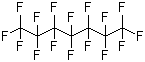
Perfluoroheptane is what happens when a familiar hydrocarbon is rebuilt almost entirely with fluorine. Replace every hydrogen in heptane with fluorine and the formula becomes C7F16. The carbon skeleton is still recognizable, yet the liquid behaves very differently from ordinary heptane. This contrast helped make perfluorocarbons central to the idea of a distinct "fluorous" phase in chemistry.
Carbon-fluorine bonds are short and strong, and the fluorine shell surrounding a perfluoroalkyl chain is poorly polarizable. Perfluorocarbons therefore interact weakly with many ordinary organic molecules. They are strongly hydrophobic, but the surprise is that they can also be lipophobic: they often mix poorly not only with water but with common hydrocarbon solvents. That unusual three-way separation among aqueous, organic, and fluorous phases led chemists to develop fluorous biphasic catalysis and fluorous tagging strategies.
In fluorous biphasic catalysis, a catalyst is modified with fluorinated groups so it prefers a perfluorocarbon-rich phase. At reaction temperature the system may become sufficiently mixed for chemistry to occur; on cooling, phases separate again, leaving products in an organic phase while catalyst remains in the fluorous phase for recovery. Perfluoroheptane and related perfluoroalkanes can serve as model or working fluorous media. An apparently inconvenient property - poor miscibility - becomes a separation tool.
Perfluorocarbons also dissolve unusually large amounts of gases such as oxygen compared with many aqueous systems, another consequence of weak cohesive interactions. That property has led to biomedical and materials research, although individual perfluorocarbons differ in boiling point, volatility, and suitability. At the same time, exceptional C-F stability carries an environmental lesson: chemical inertness can be valuable during use but can also mean persistence after release. Modern fluorine chemistry therefore evaluates performance together with recovery, containment, life-cycle behavior, and environmental persistence.
The density contrast is another practical clue that perfluorocarbons belong to a different solvent regime. Many liquid perfluoroalkanes are substantially denser than hydrocarbons, so a fluorous layer often settles below an organic layer. Yet density alone does not create the phase behavior; weak mutual interactions do. This matters experimentally because visual separation can tempt one to think of a fluorous solvent as simply a heavy organic solvent. Its true usefulness comes from selective affinity for highly fluorinated solutes, which is why fluorinated tags can direct molecules into a distinct phase.
Perfluoroheptane matters because it overturns the intuition that replacing hydrogen with fluorine merely makes a "more fluorinated heptane." Extensive fluorination creates a different solvent world with its own miscibility rules. The fluorous effect became a practical idea for catalyst recycling and molecular separation, and a broader reminder that changing every peripheral atom in a molecule can transform bulk behavior even when the carbon skeleton remains unchanged.
References:
1. Dobbs AP, Kimberley MR. Journal of Fluorine Chemistry. 2002;118:3-17. DOI: 10.1016/S0022-1139(02)00202-6.
2. Cametti M et al. Chemical Society Reviews. 2012;41:31-42. DOI: 10.1039/C1CS15084G.
3. Vincent JM et al. Coordination Chemistry Reviews. 2019;380:584-599. DOI: 10.1016/j.ccr.2018.11.004.
4. PubChem. Perfluoroheptane, CAS 335-57-9.
|




 GHS07 Warning Details
 chemBlink Chemical Story