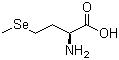
L-Selenomethionine replaces the sulfur of methionine with selenium while retaining the amino-acid framework and the methyl-substituted side chain. The structural change is small enough to allow incorporation into proteins in suitable expression systems, yet large enough to provide a valuable signal in X-ray experiments. Its formula is C₅H₁₁NO₂Se. The L configuration refers to the amino-acid center; the selenium lies farther along the side chain between carbon groups, not at that stereogenic center.
The practical significance of that substitution became clear in structural biology. A crystal diffraction experiment records a pattern of intensities, but solving a structure also requires information about phases. Ordinary protein atoms do not all supply equally convenient ways to recover that missing information. Selenium's scattering changes near an accessible X-ray absorption edge, allowing measurements at different wavelengths to provide additional information. A label that can be placed within a recombinant protein therefore becomes more than a marker of chemical composition: it contributes to solving the three-dimensional structure.
Hendrickson, Horton and LeMaster reported an influential demonstration in 1990. They established an expression system for incorporating selenomethionine into recombinant proteins in Escherichia coli and studied thioredoxins. Their work connected biosynthetic substitution to multiwavelength anomalous diffraction, usually abbreviated MAD. The purpose was to obtain structural information, not to show that adding selenium improves the protein's biological function. The labelled protein had to be prepared, crystallized and measured; the free amino acid alone did not produce a structure determination.
The comparison with selenocysteine is equally important. Selenocysteine is a different amino acid with a different side chain and a specialized role in some proteins. Incorporating selenomethionine at methionine sites is not the same process as making a selenocysteine-containing enzyme. Nor can all biological functions associated with selenium be assigned to this one chemical form. Elemental identity, amino-acid identity and the role of a residue in a protein are different levels of description.
Selenomethionine has also been investigated as a nutritional selenium source, making the boundary between biochemical rationale and clinical evidence especially relevant. The large SELECT trial evaluated L-selenomethionine and vitamin E for cancer prevention. Its initial 2009 report did not demonstrate the intended reduction in prostate-cancer risk. That finding concerns a preventive intervention in the studied population. It cannot be replaced by a general statement that selenium is required for biology, because being an essential element does not establish that additional intake produces a specific benefit.
One useful result in the 1990 work was that the labelled thioredoxins and their unlabelled counterparts formed isomorphous crystals. In that comparison, introducing selenium did not require a completely different crystal lattice. That made the substitution a practical structural probe, while remaining an observation on those proteins and preparations. It is not a universal assurance that any methionine-containing protein will express, fold or crystallize identically after replacement. The labelling strategy has to be evaluated with the actual protein.
These two research settings ask almost opposite questions of the same atom. The crystallographer wants a measurable difference in scattering that helps reveal molecular structure. The clinical investigator asks whether administering a defined chemical changes a health outcome. Evidence from one setting cannot stand in for evidence from the other. L-Selenomethionine is therefore a particularly useful example of a chemical substitution whose scientific value is clear in one application, while another application must be judged through its own experiments. The atom's presence is the starting point of the story, not the conclusion.
References:
1. Cayman Chemical. L-Selenomethionine, CAS 3211-76-5, structural identity. https://www.caymanchem.com/product/16005/l-selenomethionine
2. Hendrickson WA, Horton JR, LeMaster DM. Selenomethionyl proteins produced for analysis by multiwavelength anomalous diffraction (MAD): a vehicle for direct determination of three-dimensional structure. EMBO J. 1990;9:1665–1672. https://pmc.ncbi.nlm.nih.gov/articles/PMC551863/
3. Lippman SM et al. Effect of selenium and vitamin E on risk of prostate cancer and other cancers: SELECT. JAMA. 2009;301:39–51. https://pubmed.ncbi.nlm.nih.gov/19066370/
|







 GHS06;GHS08;GHS09 Danger Details
 chemBlink Chemical Story