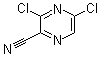
3,5-Dichloropyrazine-2-carbonitrile concentrates several kinds of reactivity in a small aromatic ring. Pyrazine is a six-membered ring with nitrogen atoms opposite each other. In this derivative, a nitrile occupies carbon 2 and chlorines occupy carbons 3 and 5. The nitrile contributes a third nitrogen outside the ring. The positions distinguish it from dichloropyridine carbonitriles, which contain a different number and arrangement of ring nitrogens.
The two chlorides are not equivalent merely because both are attached to the same ring. Once the nitrile is present, exchanging positions 3 and 5 does not preserve the complete substitution pattern. The electron-poor heteroaromatic framework can support synthetic transformations at ring substituents, but identifying a likely reaction class does not establish the selectivity of a particular preparation. That requires experimental evidence.
A concrete example appears in patent WO2019125839A1. Its synthetic discussion describes elaboration of this starting material through nucleophilic substitution with a protected benzylamine-type reagent, followed by cross-coupling with a substituted pyrazole-derived partner. The sequence illustrates the value of leaving more than one point available for construction. One operation changes the ring's substitution and the next introduces another component, producing a molecule with a different connection pattern from the starting nitrile.
The patent's subject concerns inhibitors, but the small dichloro building block is not thereby demonstrated to have the same pharmacology as the final compounds. The nitrile and chlorine substituents supply synthetic opportunities; they do not specify a biological target. Assigning the patent's activity claims directly to a starting reagent would skip the chemistry that differentiates the finished structures.
Its supported application is therefore as a heteroaromatic intermediate. The ring nitrogens establish one electronic framework, the nitrile defines both composition and position, and two carbon–chlorine sites provide distinct routes for modification. The interesting feature is not a long list of possible medicinal uses, but a documented example of how a compact ring can be elaborated step by step without losing track of which compound was actually tested.
References:
1. PubChem. 3,5-Dichloropyrazine-2-carbonitrile, CID 52987744. https://pubchem.ncbi.nlm.nih.gov/compound/52987744
2. Patent WO2019125839A1. Purine inhibitors of human phosphatidylinositol 3-kinase delta, synthetic schemes. https://patents.google.com/patent/WO2019125839A1/en
|





 GHS07 Warning Details
 chemBlink Chemical Story