
Online Database of Chemicals from Around the World
| F&F Chemical Co., Ltd. | China | |||
|---|---|---|---|---|
 | www.fnfchem.com | |||
 | +86 (10) 6444-6910 | |||
 | +86 (10) 6444-6915 | |||
 | heyifnfchem@163.com heyi@fnfchem.com | |||
 | QQ Chat | |||
| Chemical manufacturer since 1997 | ||||
| chemBlink Standard supplier since 2006 | ||||
| FKN Group Limited | China | |||
|---|---|---|---|---|
| www.golddressingagent.com | |||
| +86 13770648803 | |||
| lj436826@gmail.com | |||
| QQ Chat | |||
 | WeChat: FKN Group Limited | |||
| Chemical manufacturer since 2020 | ||||
| chemBlink Standard supplier since 2026 | ||||
| Classification | Inorganic chemical industry >> Inorganic salt >> Cyanide, cyanide oxide and cyanide complex |
|---|---|
| Name | Cyanuric acid trisodium salt |
| Synonyms | 1,3,5-Triazine-2,4,6(1H,3H,5H)-trione trisodium salt |
| Molecular Structure | 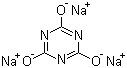 |
| Molecular Formula | C3N3Na3O3 |
| Molecular Weight | 195.02 |
| CAS Registry Number | 3047-33-4 |
| EC Number | 221-255-6 |
| SMILES | C1(=NC(=NC(=N1)[O-])[O-])[O-].[Na+].[Na+].[Na+] |
| Hazard Symbols |  GHS05 Danger Details GHS05 Danger Details |
|---|---|
| Risk Statements | H314 Details |
| Safety Statements | P260-P264-P280-P301+P330+P331-P302+P361+P354-P304+P340-P305+P354+P338-P316-P321-P363-P405-P501 Details |
| SDS | Available |
 chemBlink Chemical Story
|
Cyanuric acid trisodium salt is the fully deprotonated sodium salt of cyanuric acid, a triazine-based heterocyclic compound containing three carbonyl-equivalent (lactam/lactim) functional groups arranged symmetrically on a 1,3,5-triazine ring. Cyanuric acid and its salts are part of a well-known family of s-triazine derivatives that have been widely studied in industrial chemistry, water treatment chemistry, and polymer-related applications. The parent compound, cyanuric acid, consists of a six-membered aromatic triazine ring containing three nitrogen atoms and three carbonyl-like functionalities. It can exist in tautomeric forms involving keto–enol equilibria, often described as cyclic imide or lactam structures. Due to the presence of three acidic N–H groups, cyanuric acid can undergo stepwise deprotonation to form mono-, di-, and trisodium salts depending on pH and stoichiometry. The trisodium salt corresponds to full deprotonation, where all acidic protons are replaced by sodium ions. The chemistry of triazine derivatives has a long history in both academic and industrial contexts. s-Triazines are electron-deficient heterocycles due to the presence of three electronegative nitrogen atoms in the ring. This electron deficiency makes them susceptible to nucleophilic substitution reactions, particularly when functionalized with leaving groups. Cyanuric acid itself, however, is relatively stable due to resonance stabilization and intramolecular hydrogen bonding in its neutral form. In cyanuric acid trisodium salt, the molecule exists predominantly as the cyanurate anion. The negative charge is delocalized over the oxygen and nitrogen framework of the triazine ring, resulting in resonance stabilization of the anionic species. Sodium ions act as counterions, balancing charge and forming ionic interactions with the cyanurate framework. In the solid state, these ionic interactions often lead to highly ordered crystalline structures. Cyanurate salts are well known for their role in equilibrium chemistry with chlorinated isocyanurates. In water treatment systems, cyanuric acid and its derivatives are commonly associated with chlorine stabilization chemistry. Although cyanuric acid trisodium salt itself is not the most commonly used form in such applications, the cyanurate system plays an important role in controlling the release and stability of free chlorine in aqueous environments. From a structural perspective, the triazine ring in cyanuric acid derivatives is planar and aromatic in nature, with delocalized π-electron density distributed over the ring. The presence of three equivalent functional groups leads to high symmetry, which influences both crystallization behavior and solubility characteristics of its salts. The trisodium salt is highly ionic and therefore strongly hydrophilic. It is expected to be readily soluble in water, where it dissociates into sodium ions and cyanurate anions. The high charge density of the cyanurate ion contributes to strong hydration and extensive hydrogen bonding with surrounding water molecules. This ionic character also makes the compound largely insoluble in nonpolar organic solvents. Cyanuric acid derivatives have also been studied in the context of polymer chemistry and materials science. The triazine core can serve as a building block for the synthesis of crosslinked polymers, resins, and functional materials due to its high degree of substitution potential and thermal stability. Cyanurate-based structures are also relevant in flame retardant chemistry, where nitrogen-rich heterocycles contribute to char formation and thermal resistance. The synthesis of cyanuric acid trisodium salt is typically achieved through neutralization of cyanuric acid with sodium hydroxide under controlled conditions, allowing complete deprotonation of all three acidic sites. The resulting salt can crystallize depending on concentration, temperature, and ionic strength of the solution. Overall, cyanuric acid trisodium salt is an ionic triazine derivative formed by full deprotonation of cyanuric acid. Its significance lies in its highly symmetric cyanurate anion, strong aqueous solubility, and role in triazine-based chemistry relevant to industrial applications, particularly in aqueous systems, materials chemistry, and chlorine stabilization equilibria. References 2016. Highly Selective and Sensitive Assay for Hydrazine Based on the Plasmonic Response of Cyanurate-Stabilized Silver Nanoparticles. Plasmonics. DOI: 10.1007/s11468-016-0332-0 |
| Market Analysis Reports |