
Online Database of Chemicals from Around the World
| Jiangsu Juming Chemical Technology Co., Ltd. | China | |||
|---|---|---|---|---|
 | en.jmchemchina.com | |||
 | +86 17798763151 | |||
 | admin@jumingchem.com | |||
| Chemical manufacturer since 2017 | ||||
| chemBlink Standard supplier since 2026 | ||||
| Classification | Organic raw materials >> Ketone compound |
|---|---|
| Name | 1-(Prop-2-en-1-yl)-1,3,5-triazinane-2,4,6-trione |
| Molecular Structure | 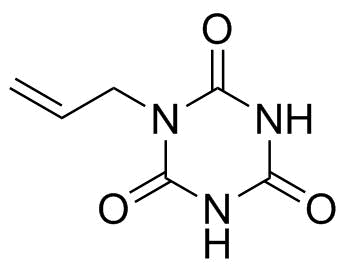 |
| Molecular Formula | C6H7N3O3 |
| Molecular Weight | 169.14 |
| CAS Registry Number | 3030-60-2 |
| SMILES | C=CCN1C(=O)NC(=O)NC1=O |
 chemBlink Chemical Story
|
CAS 3030-60-2 is monoallyl isocyanurate, systematically 1-(prop-2-en-1-yl)-1,3,5-triazinane-2,4,6-trione. The name immediately invites comparison with the much better known triallyl isocyanurate. Both share the same isocyanurate ring, but monoallyl isocyanurate carries only one allyl group; the other two ring nitrogens retain N-H functionality. That partial substitution is exactly what makes the compound synthetically interesting. The allyl group supplies a carbon-carbon double bond that can participate in radical reactions, grafting and further functionalization. At the same time, the two remaining N-H sites can be alkylated, acylated or otherwise derivatized. The molecule therefore combines one polymerizable or transformable unsaturated arm with two chemically available nitrogen positions. It is not simply an incompletely made triallyl compound; it is a building block with deliberately unequal functions. The contrast with triallyl isocyanurate helps explain the design. Triallyl isocyanurate has three allyl groups and is widely used as a multifunctional crosslinking coagent in polymer and radiation-curing chemistry. Once all three nitrogens are allylated, however, those N-H sites are gone. Monoallyl isocyanurate preserves two positions for later chemistry, allowing unsymmetrical isocyanurate derivatives to be constructed step by step. Commercial database records for CAS 3030-60-2 list C6H7N3O3 as the molecular formula and identify allyl isocyanurate as a synonym. Related-product records also connect it with 1-allyl-3,5-diglycidyl isocyanurate, a useful example of what selective further substitution can accomplish: the original allyl group is retained while the other nitrogens are converted to glycidyl-bearing positions. The isocyanurate ring itself contributes a rigid, polar tricarbonyl heterocycle. In polymer chemistry, isocyanurate-containing structures are valued because the ring can contribute thermal and chemical robustness. Combining that core with selectively installed unsaturated or epoxy-bearing side groups is a common way to make multifunctional monomers and crosslinkers. The broader lesson of CAS 3030-60-2 is that complete functionalization is not always the goal of synthesis. Sometimes the most useful intermediate is intentionally unfinished. One allyl group provides a defined reactive feature, while two N-H groups preserve options for subsequent steps. The molecule is therefore best remembered as a branching point in synthesis: a simple isocyanurate core whose partial substitution creates more choices, not fewer. References: 1. PubChem/GuideChem identity records for CAS 3030-60-2, monoallyl isocyanurate. 2. ChemicalBook, CAS 3030-60-2, allyl isocyanurate. 3. Related product record: 1-allyl-3,5-diglycidyl isocyanurate, CAS 69731-45-9. 4. CPSC, Organohalogen Flame Retardant Scope Document, 2023, background on allyl-substituted isocyanurate structures. |
| Market Analysis Reports |