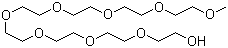
Octaethylene glycol monomethyl ether has one end ready for reaction and another deliberately capped. Its chain contains eight ethylene units, a terminal hydroxyl and a methyl ether. The formula C₁₇H₃₆O₉ differs from that of the corresponding diol because methylation replaces the hydrogen on one hydroxyl with a carbon-containing group. The result is one defined molecule rather than a molecular-weight average for a distribution of PEG chains.
A concrete synthetic example shows why that distinction is useful. Patent WO2021212638A1 describes the monomethyl ether as a starting material in preparing an ester-bearing extension of the chain. The alcohol-derived oxygen is connected to a new methylene next to a protected carboxyl group. Subsequent removal of the ester protection supplies an acid for further chemistry. The new acid is not simply the starting alcohol renamed: extra atoms have been introduced and the reactive terminus has changed.
The methyl cap helps keep that construction focused on one free alcohol. If both ends were hydroxyl groups, the same kind of transformation could occur at either end, and the product set would need additional control. Here the pre-existing ether distinguishes the ends before the next bond is made. The patent therefore documents a particular synthetic use, not an inference that every glycol with eight units behaves identically.
The wider patent concerns complex conjugates, but that subject does not confer a therapeutic action on the isolated glycol ether. A building block can participate in a research route while lacking the biological recognition elements of the finished molecule. The role established by the disclosed preparation is construction of a defined oxygen-rich segment with a new functional end.
Even within that limited role, precision matters. A fixed eight-unit chain makes the atom count of the extension knowable. It does not fix the distance between the ends in solution, where many bonds can rotate. Nor does it establish the properties of every later conjugate. The useful story is a sequence of identities: an alcohol with a methyl cap, an ester-bearing extension, then an acid. Following the changing terminus makes the synthetic purpose clearer than the general description PEG reagent.
References:
1. PubChem. Octaethylene glycol monomethyl ether, CID 526558. https://pubchem.ncbi.nlm.nih.gov/compound/526558
2. Patent WO2021212638A1. Conjugates of a cell-binding molecule with camptothecin analogs, Examples 81–82. https://patents.google.com/patent/WO2021212638A1/en
|




 GHS07 Warning Details
 chemBlink Chemical Story