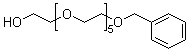
Hexaethylene glycol monobenzyl ether pairs a free terminal alcohol with a benzyl-protected oxygen at the other end of a six-unit glycol chain. The benzyl end is connected as phenyl–CH₂–O, not as a phenoxy group directly connecting the ring to oxygen. That intervening methylene matters in distinguishing the two ethers. The complete molecule is a single oligomer with a specified sequence of atoms, rather than a polymer fraction described by its average size.
The most useful chemical angle is the difference between a permanent cap and a potentially removable protecting group. A methyl-capped glycol and a benzyl-capped glycol may each begin with only one free hydroxyl group, but they offer different choices later in a synthetic sequence. Benzyl ethers are a familiar class of protecting groups that can be removed under suitable conditions. That general chemistry provides a design rationale, not a guarantee that a deprotection will be compatible with every other group in an attached molecule.
The available alcohol can be modified while the other end is kept distinct. If a later transformation reveals the protected oxygen, the molecule becomes a way of introducing a spacer in stages rather than simply attaching both ends at once. Such a plan must still account for the full substrate and the particular reaction. The registry entry alone supplies neither a universal deprotection protocol nor the yield of an untested derivative.
The ether chain has several sites that can accept hydrogen bonds, but the aromatic cap contributes a chemically different region. As a result, an uncapped glycol and its monobenzyl ether need not have the same behavior in a separation or formulation. The structure also contains many rotatable bonds, so the six-unit count identifies composition rather than a single fixed distance between the termini.
Its documented role is that of a synthetic reagent. The free alcohol, defined spacer and benzyl ether together make a useful example of temporary asymmetry: one end can be addressed while the other is reserved for a later decision. No therapeutic action or specific performance of a finished conjugate follows from that synthetic identity.
References:
1. PubChem. Hexaethylene glycol monobenzyl ether, CID 11164646. https://pubchem.ncbi.nlm.nih.gov/compound/11164646
2. TCI. Hexaethylene glycol monobenzyl ether, H1043, CAS 24342-68-5. https://www.tcichemicals.com/US/en/p/H1043
|





 GHS07 Warning Details
 chemBlink Chemical Story