
Online Database of Chemicals from Around the World
| Okeanos Tech. Jiangsu Co., Ltd. | China | |||
|---|---|---|---|---|
 | www.okeanospharm.com | |||
 | +86 (510) 8663-6249 | |||
 | +86 (510) 8609-3680 | |||
 | sales@okeanospharm.com | |||
| Chemical manufacturer since 2006 | ||||
| chemBlink Standard supplier since 2010 | ||||
| BOC Sciences | USA | |||
|---|---|---|---|---|
| www.bocsci.com | |||
| +1 (631) 485-4226 | |||
| +1 (631) 614-7828 | |||
| info@bocsci.com | |||
| Chemical manufacturer | ||||
| chemBlink Standard supplier since 2010 | ||||
| Creative Peptides | USA | |||
|---|---|---|---|---|
| www.creative-peptides.com | |||
| +1 (631) 624-4882 | |||
| +1 (631) 614-7828 | |||
| info@creative-peptides.com | |||
| Chemical manufacturer | ||||
| chemBlink Standard supplier since 2010 | ||||
| Amadis Chemical Co., Ltd. | China | |||
|---|---|---|---|---|
| www.amadischem.com | |||
| +86 (571) 8992-5085 | |||
| +86 (571) 8992-5065 | |||
| sales@amadischem.com | |||
| Chemical manufacturer since 2010 | ||||
| chemBlink Standard supplier since 2015 | ||||
| Changzhou Jiuwu Chemical Co., Ltd. | China | |||
|---|---|---|---|---|
| www.jiuwuchem.com | |||
| +86 (519) 8512-1086 +86 13775162768 | |||
| +86 (519) 8512-5369 | |||
| info@jiuwuchem.cn | |||
 | QQ Chat | |||
| Chemical manufacturer since 2009 | ||||
| chemBlink Standard supplier since 2023 | ||||
| AnaSpec, Inc. | USA | |||
|---|---|---|---|---|
| www.anaspec.com | |||
| +1 (800) 452-5530 | |||
| +1 (510) 791-9560 | |||
| service@anaspec.com | |||
| Chemical manufacturer | ||||
| Watanabe Chemical Ind., Ltd. | Japan | |||
|---|---|---|---|---|
| www.watanabechem.co.jp | |||
| +81 (82) 231-0540 | |||
| +81 (82) 231-1451 | |||
| inquiry@watanabechem.co.jp | |||
| Chemical manufacturer | ||||
| Classification | Biochemical >> Amino acids and their derivatives >> Lysine derivative |
|---|---|
| Name | Fmoc-N',N',N'-trimethyl-L-lysine chloride |
| Synonyms | N-[(9H-Fluoren-9-ylmethoxy)carbonyl]-N',N',N'-trimethyl-L-lysine chloride; Fmoc-Lys(Me)3-OH chloride |
| Molecular Structure | 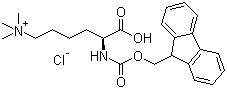 |
| Molecular Formula | C24H31ClN2O4 |
| Molecular Weight | 446.97 |
| Protein Sequence | X |
| CAS Registry Number | 201004-29-7 |
| SMILES | C[N+](C)(C)CCCC[C@@H](C(=O)O)NC(=O)OCC1C2=CC=CC=C2C3=CC=CC=C13.[Cl-] |
| Hazard Symbols |  GHS07 Warning Details |
|---|---|
| Risk Statements | H302-H315-H319-H332-H335 Details |
| Safety Statements | P261-P280-P305+P351+P338 Details |
| SDS | Available |
 chemBlink Chemical Story
|
Three methyl groups can turn the end of a lysine side chain into a distinct molecular recognition feature. Fmoc-N',N',N'-trimethyl-L-lysine chloride, CAS 201004-29-7, allows that feature to be built into synthetic peptides. Its most compelling context is the study of protein modification, where an exactly placed methylation state can help researchers ask how other molecules recognize a histone sequence. The trimethylation is on the side-chain nitrogen, not on the alpha-amino nitrogen or the carboxyl group. The epsilon nitrogen is attached to the lysine carbon chain and three methyl groups, giving a quaternary ammonium center. Chloride serves as a counterion; it is not covalently attached to carbon. Fmoc temporarily masks the alpha-amino group, while the carboxyl group provides the coupling function. This distinction changes the interpretation of methylation. The three groups are part of the intended modified residue, rather than three temporary masks to be removed at the end of ordinary peptide assembly. A trimethylated side-chain nitrogen also has no N-H bond, unlike unmodified lysine or some lower methylation states. Its positive quaternary charge is not switched off by the same simple deprotonation that can neutralize an ordinary ammonium group. Histones provide the biological setting. Their amino-acid sequences can carry covalent modifications, and lysine methylation can occur at different positions and to different extents. Recognition depends on both the modification and its sequence context. It would therefore be misleading to call all trimethyllysine residues interchangeable signals, or to assign one universal activating or repressing effect to the presence of three methyl groups. Synthetic peptides let researchers specify such variables directly. One sequence can be prepared in unmodified, mono-, di-, or trimethylated forms and compared with related sequences. A premodified building block is useful because the desired side-chain state is introduced at a chosen position during assembly. The protected reagent is a means of preparing the test molecules, not a substitute for the chromatin system they help investigate. In 2012, Rothbart and colleagues described peptide microarrays for interrogating the histone code. Their methods included constructing combinatorially modified histone peptides and studying recognition by proteins and antibodies. Novabiochem identifies the present building block for introducing trimethyllysine in Fmoc synthesis and cites that work. Together, these sources link a defined reagent to an established experimental platform without turning a supplier description into a clinical claim. An array can compare many defined peptide surfaces, but it remains a model. A short immobilized segment does not contain every feature of a nucleosome or a living cell. Binding observed on the array supports a recognition interaction under those conditions; it does not alone establish a complete cellular mechanism. Follow-up experiments can test whether the same relationship holds in a larger biological setting. The word epigenetic can otherwise obscure the chemistry. Adding methyl groups to a histone lysine changes a protein side chain; it does not rewrite the sequence of DNA bases. Connecting that local modification to gene regulation requires evidence about recognition and the broader chromatin environment, beyond confirming the modified residue's chemical structure. This reagent's significance lies in making a precise molecular question experimentally accessible. The temporary Fmoc group controls assembly, the chloride balances charge, and the retained trimethylammonium side chain supplies the feature to be recognized. Keeping those roles separate explains how a small synthetic building block can contribute to investigating the much larger problem of chromatin regulation. References: 1. Novabiochem. Fmoc-Lys(Me3Cl)-OH, product 852112; CAS 201004-29-7 and histone-peptide application. https://www.sigmaaldrich.com/US/en/product/mm/852112 2. Rothbart SB et al. Peptide microarrays to interrogate the histone code. Methods in Enzymology (2012). https://doi.org/10.1016/B978-0-12-391940-3.00006-8 |
| Market Analysis Reports |