
Online Database of Chemicals from Around the World
| R&D Scientific Inc. | Canada | |||
|---|---|---|---|---|
 | www.rdscientific.com | |||
 | +1 (226) 600-0236 | |||
 | sales@rdscientific.com | |||
| Chemical manufacturer since 2016 | ||||
| chemBlink Standard supplier since 2023 | ||||
| wuhan chemi Pharmacy Chemical Technology Co., Ltd. | China | |||
|---|---|---|---|---|
| www.chemipharm.com.cn | |||
| +86 13971619949 | |||
| gmn424@chemipharm.com.cn | |||
 | QQ Chat | |||
 | WeChat: 13971619949 | |||
| Chemical manufacturer since 2014 | ||||
| chemBlink Standard supplier since 2026 | ||||
| Classification | Chemical reagent >> Organic reagent >> Thiol salt |
|---|---|
| Name | 4-Mercapto-1-butanol |
| Molecular Structure | 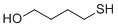 |
| Molecular Formula | C4H10OS |
| Molecular Weight | 106.19 |
| CAS Registry Number | 14970-83-3 |
| EC Number | 628-399-2 |
| SMILES | C(CCS)CO |
| Solubility | 2.393e+004 mg/L (25 °C water) |
|---|---|
| Density | 1.0±0.1 g/cm3, Calc.* |
| Index of Refraction | 1.478, Calc.* |
| Melting point | -21.90 °C |
| Boiling Point | 189.92 °C, 190.4±23.0 °C (760 mmHg), Calc.* |
| Flash Point | 68.9±22.6 °C, Calc.* |
| * | Calculated using Advanced Chemistry Development (ACD/Labs) Software. |
| Hazard Symbols |  GHS07 Warning Details GHS07 Warning Details | ||||||||||||||||||||
|---|---|---|---|---|---|---|---|---|---|---|---|---|---|---|---|---|---|---|---|---|---|
| Risk Statements | H315-H319 Details | ||||||||||||||||||||
| Safety Statements | P261-P264-P264+P265-P271-P280-P302+P352-P304+P340-P305+P351+P338-P319-P321-P332+P317-P337+P317-P362+P364-P403+P233-P405-P501 Details | ||||||||||||||||||||
| Hazard Classification | |||||||||||||||||||||
| |||||||||||||||||||||
| SDS | Available | ||||||||||||||||||||
 chemBlink Chemical Story
|
4-Mercapto-1-butanol is a small bifunctional organosulfur compound containing both a primary alcohol group and a terminal thiol group on a four-carbon linear chain. The molecule can be viewed as a butanol derivative in which the carbon chain is substituted with a sulfhydryl (–SH) group at the 4-position. This combination of hydroxyl and thiol functionalities gives the compound distinct chemical reactivity and makes it useful as a versatile building block in organic synthesis. The chemistry of low-molecular-weight thiols and alcohols has been studied extensively since the development of modern organic functional group theory in the nineteenth and early twentieth centuries. Thiols, as sulfur analogues of alcohols, exhibit higher nucleophilicity and greater susceptibility to oxidation than their oxygen counterparts. The presence of both functional groups within a single molecule allows for differential reactivity, which is frequently exploited in synthetic and materials chemistry. In 4-mercapto-1-butanol, the hydroxyl group at the terminal carbon imparts hydrophilicity and hydrogen-bonding capability, while the thiol group introduces nucleophilic and redox-active character. Thiols are known to undergo oxidation to form disulfides under mild oxidative conditions, a transformation that plays an important role in both biological systems and synthetic polymer chemistry. Alcohol groups, by contrast, are relatively stable but can be activated for substitution or esterification reactions. Bifunctional thiol–alcohol compounds such as 4-mercapto-1-butanol are commonly used as intermediates in the synthesis of more complex molecules. The presence of two distinct reactive sites enables selective derivatization strategies, where one functional group can be modified while the other is preserved. For example, the hydroxyl group may be esterified or converted into a leaving group, while the thiol can participate in nucleophilic substitution or coupling reactions. Thiol-containing compounds are particularly important in surface chemistry and materials science. The strong affinity of sulfur for many metal surfaces, especially gold, allows thiols to form self-assembled monolayers through metal–sulfur bonding. In this context, 4-mercapto-1-butanol and related compounds can be used as surface-modifying agents, where the hydroxyl terminus can influence surface hydrophilicity and intermolecular interactions while the thiol anchors the molecule to a substrate. From a physicochemical perspective, 4-mercapto-1-butanol is expected to be a polar, low-molecular-weight liquid with moderate water solubility due to its hydroxyl group. The thiol group contributes to its characteristic odor, a common feature of small sulfur-containing organic molecules. The compound’s amphiphilic nature arises from the coexistence of a hydrophilic alcohol group and a relatively hydrophobic alkyl chain, balanced by the polarizable sulfur atom. In organic synthesis, thiol–alcohol compounds are often used as linkers or spacers in the construction of more complex architectures. The thiol group can participate in Michael addition reactions to activated alkenes, while the alcohol group can be used for further functionalization or coupling reactions. This dual reactivity makes such molecules valuable intermediates in the preparation of polymers, cross-linked materials, and multifunctional small molecules. The redox chemistry of thiols is also a key aspect of their behavior. Under oxidative conditions, thiols can form disulfide bonds, which are reversible under reducing conditions. This property is widely exploited in biochemistry, where disulfide bond formation plays a critical role in protein folding and stability. While 4-mercapto-1-butanol is not a biological thiol, it shares the same fundamental chemical reactivity. Overall, 4-mercapto-1-butanol is a bifunctional organosulfur compound containing both thiol and alcohol functional groups on a short aliphatic chain. Its significance lies in its dual reactivity, enabling applications in organic synthesis, surface modification, and materials chemistry, where controlled functional group chemistry is essential for building more complex molecular systems. References 2020. Formation of thioesters by dehydrogenative coupling of thiols and alcohols with H2 evolution. Nature Catalysis. DOI: 10.1038/s41929-020-00514-9 2019. Progress in rapid optical assays for heavy metal ions based on the use of nanoparticles and receptor molecules. Microchimica Acta. DOI: 10.1007/s00604-018-3168-9 2018. Highly sensitive electrochemical biosensor based on redox - active monolayer for detection of anti-hemagglutinin antibodies against swine-origin influenza virus H1N1 in sera of vaccinated mice. BMC Veterinary Research. URL: https://www.ncbi.nlm.nih.gov/pmc/articles/PMC6218974 |
| Market Analysis Reports |