
Online Database of Chemicals from Around the World
| BOC Sciences | USA | |||
|---|---|---|---|---|
 | www.bocsci.com | |||
 | +1 (631) 485-4226 | |||
 | +1 (631) 614-7828 | |||
 | info@bocsci.com | |||
| Chemical manufacturer | ||||
| chemBlink Standard supplier since 2010 | ||||
| Chengdu Biopurify Phytochemicals Ltd. | China | |||
|---|---|---|---|---|
| www.phytopurify.com | |||
| +86 (28) 8263-3860 8263-3987 | |||
| +86 (28) 8263-3165 | |||
| sales@biopurify.com biopurify@gmail.com | |||
 | QQ Chat | |||
 | Skype Chat | |||
| Chemical manufacturer | ||||
| chemBlink Standard supplier since 2017 | ||||
| Nutrition BioTech USA Inc. | USA | |||
|---|---|---|---|---|
| www.naturalbestbio.com | |||
| +1 (909) 745-1357 | |||
| sales@naturalbestbio.com | |||
| Chemical manufacturer since 2024 | ||||
| chemBlink Standard supplier since 2026 | ||||
| Classification | Natural product >> Flavonoids |
|---|---|
| Name | Chrysosplenol D |
| Synonyms | 5,3',4'-Trihydroxy-3,6,7-trimethoxyflavone |
| Molecular Structure | 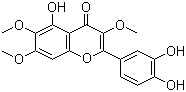 |
| Molecular Formula | C18H16O8 |
| Molecular Weight | 360.32 |
| CAS Registry Number | 14965-20-9 |
| SMILES | COC1=C(C(=C2C(=C1)OC(=C(C2=O)OC)C3=CC(=C(C=C3)O)O)O)OC |
| Density | 1.5±0.1 g/cm3 Calc.* |
|---|---|
| Boiling point | 645.0±55.0 °C 760 mmHg (Calc.)* |
| Flash point | 237.3±25.0 °C (Calc.)* |
| Index of refraction | 1.68 (Calc.)* |
| * | Calculated using Advanced Chemistry Development (ACD/Labs) Software. |
| Hazard Symbols |  GHS07 Warning Details |
|---|---|
| Risk Statements | H302-H315-H319-H335 Details |
| Safety Statements | P261-P305+P351+P338 Details |
| SDS | Available |
 chemBlink Chemical Story
|
Chrysosplenol D is an oxygenated flavonoid recorded in sweet wormwood, Artemisia annua. Its name is less informative than its substitution pattern. Three positions carry methoxy groups and three carry hydroxyl groups. Two of the hydroxyls are neighbors on the pendant aromatic ring. The other ring system contains the carbonyl characteristic of a flavone framework. These features distinguish the compound from other flavonoids in the same plant, even when their drawings look almost interchangeable. The contrast between hydroxyl and methoxy groups helps explain why position matters. A phenolic hydroxyl can donate a hydrogen bond, whereas the corresponding methyl ether lacks that hydrogen. Both retain oxygen, so merely counting oxygen atoms does not tell an analyst what interactions are possible. In addition, moving one methoxy group to another position need not change the molecular formula. Identifying a compound in a plant extract therefore requires evidence about its substitution pattern, not just a mass consistent with a flavonoid. A published study examined chrysosplenol D and casticin from Artemisia annua in experimental models of inflammation. The relevance of comparing named constituents is that a plant extract contains many compounds and an observation about the whole mixture cannot automatically be assigned to one of them. The study addressed effects under its particular experimental conditions. It does not establish that chrysosplenol D treats an inflammatory disease in people or that a preparation of the plant supplies an equivalent exposure. Sweet wormwood is also known for artemisinin, but the two molecules belong to different structural classes. Artemisinin's peroxide-containing framework should not be confused with a methoxylated flavonoid. A plant name is a clue to origin, not an indication that its constituents share a structure or activity. The value of this entry is to give one constituent a precise chemical identity and keep the evidence for that constituent separate from evidence about its botanical source. References: 1. KNApSAcK. Chrysosplenol D, C00004692. https://www.knapsackfamily.com/knapsack_core/information.php?word=C00004692 2. Experimental study of casticin and chrysosplenol D from Artemisia annua. https://pubmed.ncbi.nlm.nih.gov/25891417/ |
| Market Analysis Reports |