Replacing a benzene ring with a sulfur-containing aromatic ring can turn a familiar amino-acid framework into a useful experimental variation. (S)-N-Fmoc-2-thienylalanine, CAS 130309-35-2, provides such a variation in a form suitable for peptide assembly. Its interest extends beyond ordinary chain construction to studies asking how aromatic side chains influence the way peptides organize themselves.
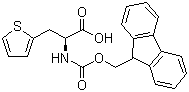
The amino-acid core is 3-(thiophen-2-yl)-L-alanine. A methylene group connects the alpha carbon to a five-membered thiophene ring, with attachment at the ring's 2 position. The molecule remains an alpha-amino acid: the shorthand thienylalanine does not mean that its amino group has moved onto the beta carbon. Fmoc protects the alpha-amino group, leaving the carboxyl function available for coupling.
The sulfur here belongs to an aromatic ring. It is neither a free thiol nor the sulfur of a disulfide bridge. Consequently, a thiophene-containing residue should not be assigned the familiar thiol reactivity of cysteine merely because both contain sulfur. The ring changes the electronic distribution, shape, and polarizability of the side chain while keeping an aromatic surface that can participate in intermolecular packing.
Phenylalanine offers a useful comparison because it also places an aromatic ring beyond a methylene group. Nevertheless, thiophene is not simply benzene with a label changed. The ring sizes and atom types differ. Substitution can therefore be used to investigate which features of a peptide depend on a particular aromatic group, without assuming that the replacement is functionally equivalent in every sequence.
A 2010 study by Ian Hamley and colleagues investigated a designed amyloid-related peptide containing thienylalanine units. The authors used a sequence derived from an amyloid peptide design motif and examined its self-assembly in different solvents. This is evidence for the scientific use of the incorporated residue in a larger peptide, not evidence that the isolated Fmoc-protected reagent itself forms the same assemblies or causes an amyloid disease.
Self-assembly asks how many peptide molecules associate through noncovalent interactions. Peptide synthesis asks how amino-acid units are connected covalently in the first place. Keeping those stages separate is important: a defined sequence must first be prepared and characterized before its aggregation behavior can be interpreted. The temporary Fmoc group belongs to the synthetic stage and can otherwise introduce its own aromatic contribution if left attached.
The resulting assemblies depend on more than one side chain. Sequence order, concentration, solvent, and the surrounding chemical conditions influence intermolecular association. A finding for a particular thienylalanine-containing sequence does not establish a universal material property of every peptide using the same building block. Structural measurements are needed to distinguish an ordered assembly from the mere appearance of a cloudy solution.
An assembled fiber should also be distinguished from a newly polymerized chain. In a noncovalent assembly, many already synthesized peptide molecules associate without necessarily forming new backbone bonds between them. The dimensions of the aggregate can grow while each constituent retains its original sequence. This separates supramolecular organization from simply extending a peptide by another coupling step.
This example shows why noncanonical amino acids can be valuable even when they are not medicines. They let researchers alter a recognizable structural feature while retaining much of the peptide framework. In this case, an aromatic sulfur-containing ring becomes a way to explore molecular packing and supramolecular organization. The protected reagent is the means of making that controlled variation; the assembled peptide is the object whose behavior must be measured.
References:
1. Bachem. Fmoc-beta-(2-thienyl)-Ala-OH, product 4009752; CAS 130309-35-2. https://shop.bachem.com/product/4009752/
2. Hamley IW et al. Self-assembly of a designed amyloid peptide containing the functional thienylalanine unit. Journal of Physical Chemistry B (2010). https://doi.org/10.1021/jp105508g
|





 GHS07 Warning Details
 chemBlink Chemical Story