
Online Database of Chemicals from Around the World
| Simagchem Corporation | China | |||
|---|---|---|---|---|
 | www.simagchem.com | |||
 | +86 13806087780 | |||
 | +86 (592) 268-0237 | |||
 | sale@simagchem.com | |||
| Chemical manufacturer since 2002 | ||||
| chemBlink Standard supplier since 2008 | ||||
| Hefei TNJ Chemical Industry Co., Ltd. | China | |||
|---|---|---|---|---|
| www.tnjchem.com | |||
| +86 (551) 6541-8684 | |||
| +86 (551) 6541-8697 | |||
| sales@tnjchem.com | |||
| Chemical manufacturer since 2001 | ||||
| chemBlink Standard supplier since 2010 | ||||
| Karnchem Corporation | India | |||
|---|---|---|---|---|
| www.karnchem.com | |||
| +91 (98) 2404-1224 | |||
| +91 (265) 233-1224 | |||
| drvyas@karnchem.com | |||
| Chemical manufacturer since 1994 | ||||
| chemBlink Standard supplier since 2010 | ||||
| Ereztech LLC | USA | |||
|---|---|---|---|---|
| www.ereztech.com | |||
| +1 (888) 658-1221 | |||
| sales@ereztech.com | |||
| Chemical distributor since 2010 | ||||
| chemBlink Standard supplier since 2011 | ||||
| Changsha Weichuang Chemical Co., Ltd. | China | |||
|---|---|---|---|---|
| www.weichuangchem.com | |||
| +86 (731) 8476-5733 | |||
| lilian214@hotmail.com | |||
| Chemical distributor since 2007 | ||||
| chemBlink Standard supplier since 2012 | ||||
| Hangzhou Leap Chem Co., Ltd. | China | |||
|---|---|---|---|---|
| www.leapchem.com | |||
| +86 (571) 8771-1850 | |||
| market19@leapchem.com | |||
 | QQ Chat | |||
| Chemical manufacturer since 2006 | ||||
| chemBlink Standard supplier since 2015 | ||||
| Riverland Trading LLC. | USA | |||
|---|---|---|---|---|
| www.riverlandtrading.com | |||
| +1 (336).944-2293 | |||
| bens@riverlandtrading.com | |||
| Chemical distributor | ||||
| chemBlink Standard supplier since 2023 | ||||
| Mudanjiang Fengda Chemicals Import and Export Co., Ltd. | China | |||
|---|---|---|---|---|
| www.mudanjiangchem.com | |||
| +86 (453) 625-5887 | |||
| +86 (453) 629-6887 / 622-3551 | |||
| fengda@mudanjiangchem.com | |||
 | WeChat: fengdachem | |||
 | WhatsApp:+8615645398875 | |||
| Chemical distributor since 1995 | ||||
| chemBlink Standard supplier since 2026 | ||||
| Polysciences, Inc. | USA | |||
|---|---|---|---|---|
| www.polysciences.com | |||
| +1 (215) 343-6484 | |||
| +1 (215) 343-0214 | |||
| info@polysciences.com | |||
| Chemical manufacturer since 1961 | ||||
| ProChem, Inc. | USA | |||
|---|---|---|---|---|
| www.prochemonline.com | |||
| +1 (815) 398-1788 | |||
| +1 (815) 398-1810 | |||
| prochem3@aol.com | |||
| Chemical manufacturer since 1986 | ||||
| Chemos GmbH & Co. KG | Germany | |||
|---|---|---|---|---|
| www.chemos.de | |||
| +49 871-966346-0 | |||
| +49 871-966346-13 | |||
| chemos@chemos.de | |||
| Chemical distributor | ||||
| Springchem & Jadetextile Group Limited | China | |||
|---|---|---|---|---|
| www.spring-chem.com | |||
| +86 (21) 5175-2788 5175-2786 | |||
| +86 (21) 5175-2789 | |||
| shachunyu@spring-chem.com | |||
| Chemical manufacturer | ||||
| Avonchem/Chromos Express Ltd. | UK | |||
|---|---|---|---|---|
| www.avonchem.co.uk | |||
| +44 (1625) 434-300 | |||
| +44 (1625) 869-777 | |||
| info@avonchem.co.uk | |||
| Chemical manufacturer | ||||
| Boya (Tianjin) International Limited | China | |||
|---|---|---|---|---|
| www.boya-chemical.com | |||
| +86 (22) 2430-2708 2430-2718 | |||
| +86 (22) 2430-2728 / 2430-2738 | |||
| boya.chemical@163.com | |||
| Chemical distributor | ||||
| Classification | API >> Special medicine >> Antidote |
|---|---|
| Name | Sodium thiosulfate pentahydrate |
| Synonyms | disodium;dioxido-oxo-sulfanylidene-λ6-sulfane;pentahydrate |
| Molecular Structure | 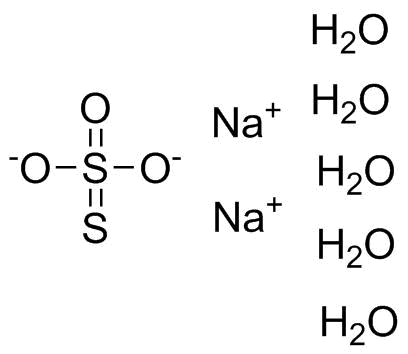 |
| Molecular Formula | Na2S2O3.5(H2O) |
| Molecular Weight | 248.17 |
| CAS Registry Number | 10102-17-7 |
| EC Number | 600-156-5 |
| SMILES | O.O.O.O.O.[O-]S(=O)(=S)[O-].[Na+].[Na+] |
| Density | 1.69 g/mL (Expl.) |
|---|---|
| Melting point | 48 °C (Expl.) |
| Boiling point | 100 - 105 °C (Expl.) |
| Solubility | Soluble in water. Insoluble in alcohol (Expl.) |
| Hazard Symbols |  GHS07 Warning Details GHS07 Warning Details | ||||||||||||||||||||||||||||
|---|---|---|---|---|---|---|---|---|---|---|---|---|---|---|---|---|---|---|---|---|---|---|---|---|---|---|---|---|---|
| Risk Statements | H315-H319-H335 Details | ||||||||||||||||||||||||||||
| Safety Statements | P261-P305+P351+P338 Details | ||||||||||||||||||||||||||||
| Hazard Classification | |||||||||||||||||||||||||||||
| |||||||||||||||||||||||||||||
| SDS | Available | ||||||||||||||||||||||||||||
 chemBlink Chemical Story
|
Sodium thiosulfate pentahydrate, CAS 10102-17-7, is a water-soluble inorganic salt with the formula Na2S2O3·5H2O and a molecular weight of approximately 248.18. It is widely used as a reducing agent, complexing agent, analytical reagent, dechlorinating agent, and photographic chemical. For generations of photographers it was known simply as "hypo," a name inherited from the older term hyposulfite of soda. Its place in the history of photography comes from an unusual ability of the thiosulfate ion: it can make sparingly soluble silver halides disappear into solution. Traditional photographic film and paper contain light-sensitive silver halide crystals, commonly including silver bromide. Exposure to light creates a latent image, and development converts the exposed regions into metallic silver. At this stage the visible image has formed, but the photographic material still contains silver halide that was not exposed and therefore was not developed. Leaving those crystals in place would create a serious problem. They remain sensitive to light, so a developed photograph brought into daylight could continue changing. Previously unexposed material would eventually darken, fogging and destroying the image. Development therefore creates the picture, but another chemical step is required to make that picture stable. That step is fixing. Thiosulfate binds silver ions strongly enough to form soluble silver-thiosulfate complexes. As silver ions are removed into these complexes, the remaining silver halide can dissolve and be washed from the photographic emulsion. A simplified representation is: AgX + 2 S2O32− → [Ag(S2O3)2]3− + X− where X represents a halide such as bromide. The metallic silver forming the desired black-and-white image remains, while the unwanted light-sensitive silver halide is removed. After adequate fixing and washing, ordinary light can no longer continue developing the unexposed regions. The image has become much more permanent. This apparently simple chemical property was crucial to the emergence of practical photography. Sir John Herschel investigated the ability of thiosulfate solutions to dissolve silver salts in the early nineteenth century and communicated its usefulness to the pioneers of photography. By 1839, he had shown that sodium thiosulfate could be used to fix photographic images. The discovery solved one of early photography's fundamental problems: how to preserve a light-created image after it had been made. The chemistry was so successful that sodium thiosulfate became a standard photographic fixer and remained closely associated with darkroom processing for generations. Ammonium thiosulfate later became important in faster modern fixing formulations, but the underlying chemistry is the same: soluble silver-thiosulfate complexes remove the undeveloped silver halide. This same ion has another important talent. Thiosulfate is a mild reducing agent and reacts readily with oxidizing halogens. That property explains another major use of sodium thiosulfate: removing residual chlorine from water. Chlorine and hypochlorite are useful disinfectants precisely because they are strong oxidizing agents. Once disinfection has served its purpose, however, residual oxidant may need to be eliminated before a water sample is analyzed, before treated water is discharged under certain conditions, or in other processes sensitive to chlorine. Sodium thiosulfate provides a convenient chemical way to do this. It reduces active chlorine to chloride while the thiosulfate itself is oxidized. The World Health Organization specifies sodium thiosulfate for neutralizing chlorine in procedures used to evaluate water-disinfection systems. Standard microbiological water-sampling procedures also use it in collection bottles so that residual chlorine does not continue killing microorganisms while the sample is being transported to the laboratory. Without neutralization, the microbial count measured later could fail to represent the condition of the water at the moment the sample was collected. The reducing behavior of thiosulfate also made it one of the classic reagents of quantitative analytical chemistry. Iodine reacts predictably with thiosulfate: I2 + 2 S2O32− → 2 I− + S4O62− This reaction forms the basis of iodometric titrations used to determine numerous oxidizing substances. A chemist can convert the substance being measured into an equivalent amount of iodine and then determine that iodine accurately with standardized sodium thiosulfate solution. The disappearance of the characteristic iodine-starch color provides a sensitive indication near the endpoint. These applications may appear unrelated: preserving photographs, removing chlorine from water, and measuring oxidants in an analytical laboratory. Chemically, however, they arise from two complementary properties of the same thiosulfate ion. It forms useful complexes with silver, and it transfers electrons readily to suitable oxidizing substances. Few people using a digital camera today need to think about photographic fixer, yet sodium thiosulfate played a quiet role in making photography practical for well over a century. The developer revealed the image, but the fixer allowed the image to survive the light. The same compound later found important roles wherever chemists needed to remove an oxidant or measure one accurately. Sodium thiosulfate pentahydrate therefore provides a good example of how one simple inorganic salt can connect technological history with modern laboratory practice. In the darkroom it removed the silver salts that threatened a photograph. In water treatment it removes oxidizing chlorine after chlorine has done its job. In analytical chemistry it makes invisible quantities of oxidants measurable. In each case, its usefulness comes from the same fundamental principle: control the chemical species that should no longer remain. References 1. Canadian Conservation Institute. Processing Contemporary Black-and-White Photographic Films and Papers for Maximum Permanence. Description of thiosulfate fixing and removal of undeveloped silver halides. 2. U.S. Environmental Protection Agency. Guidance Document for the Control of Water Pollution in the Photographic Processing Industry. Sodium or ammonium thiosulfate as the principal ingredient of photographic fixer. 3. Uryu, T. (1952). "Studies on the photographic fixing process." Journal of the Society of Photographic Science and Technology of Japan, 14, 114-124. 4. World Health Organization. Harmonized Testing Protocol for the WHO International Scheme to Evaluate Household Water Treatment Technologies. Use of sodium thiosulfate for chlorine neutralization. 5. Standard methods for microbiological examination of water. Use of sodium thiosulfate to neutralize residual halogens during sample collection. |
| Market Analysis Reports |